Iridescence is a fascinating optical phenomenon commonly seen in insects and birds, but it is surprisingly rare among amphibians. Researchers have discovered a striking example of this effect in a well-known Australian frog species.
A hidden secret of Dryopsophus aureus
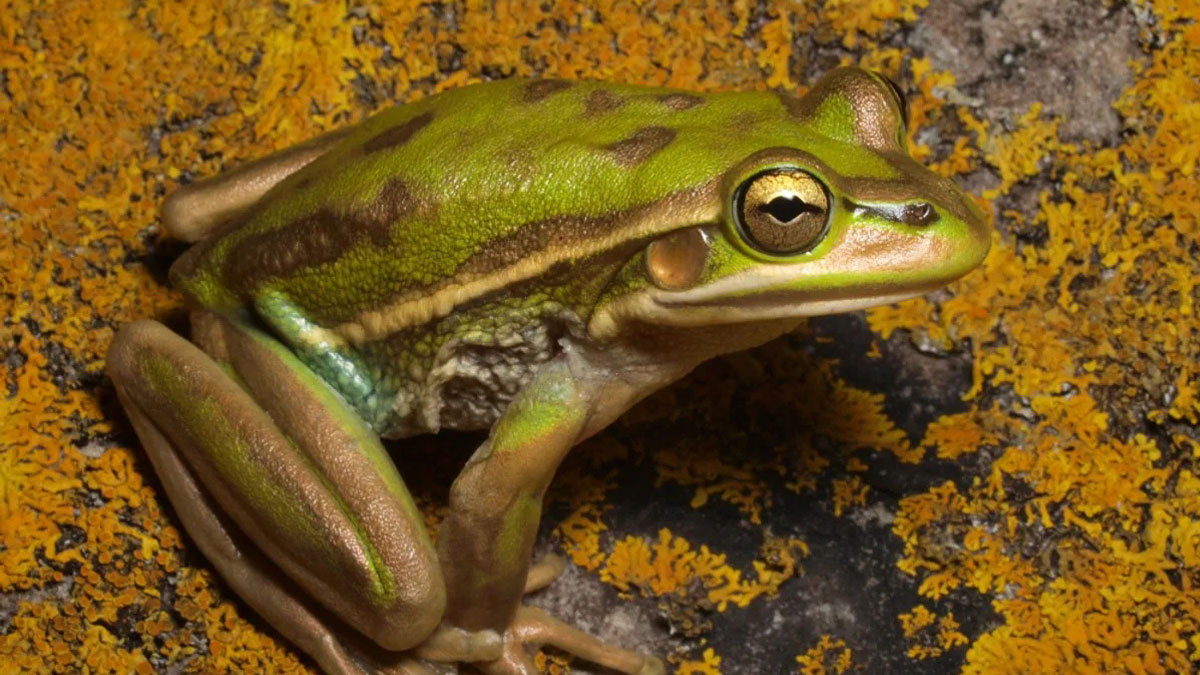
The green and gold bell frog (Dryopsophus aureus), native to eastern Australia, ranks among the country’s largest frog species, weighing about fifty grams. Known for its insatiable appetite, this robust amphibian consumes substantial amounts of insects, making it a target for various predators, including wading birds, snakes, fish, and wild canids.
In a bid to enhance understanding of this creature’s anti-predator strategies, biologist John Gould and his colleagues from the University of Newcastle collected three adult specimens, one male and two females, from Kooragang Island in New South Wales. Their examination revealed a distinctive bright, metallic sheen on the insides of the frogs’ thighs.
“Iridescence is an extraordinary optical effect often noted in birds, characterized by a change in tissue color depending on the angle of observation,” the study’s authors explain in their recent publication in Austral Ecology. “When handling these frogs, the skin on the inner thighs shifted from deep blue to shades of turquoise, while the outer part maintained its typical green speckled tint.”
The fact that this pair of “shorts” only becomes visible when the frog leaps suggests a unique case of “flash coloring,” designed to surprise and confuse its predators. “The iridescence enhances this visual signal to maximize its effects,” Gould suggests.
Complex skin
While the identification of iridescence in a species known to science for nearly 200 years implies it might occur in other previously described species, it also deepens our understanding of the rare bluish pigmentation in the animal kingdom.
In frogs, the blue coloration arises from the scattering of light through microscopic skin structures. Previously thought to be randomly distributed, the optical phenomenon observed in D. aureus indicates a delicate organizational structure.
“This research shows that amphibian skin is far more complex than previously believed,” concludes Gould.
Earlier studies have shown that iridescence can help beetles camouflage effectively.