Planting billions of trees seems like a straightforward solution to climate change. However, China’s recent efforts illustrate that not all reforestation initiatives are equal. Behind the revitalized dunes lies a nuanced reality: different forests absorb carbon at varying rates.
China’s green wall has changed the fight against desertification
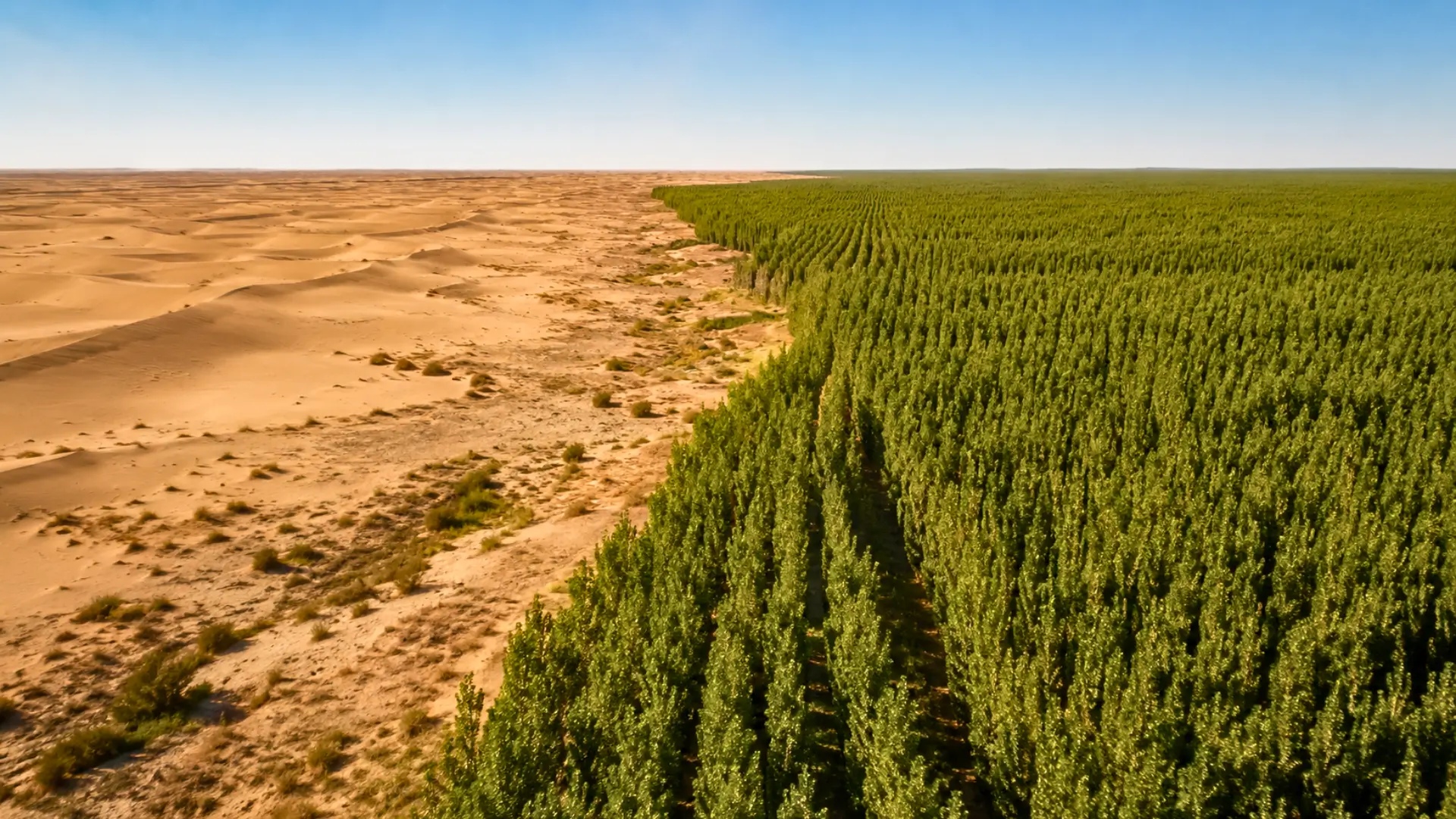
In 1978, China embarked on an ambitious project to create a “green barrier” against the Gobi and Taklamakan deserts. To date, nearly 66 billion trees have been planted as part of the Three-North Shelter Forest program, with a goal of reaching 100 billion by 2050. Few ecological initiatives have matched its scale and symbolic significance.
For a long time, this project has been narrated primarily as a heroic battle against desertification. However, from a satellite’s perspective, the story shifts. In some of Asia’s driest regions, plantations have progressed enough to alter the vegetative cover. In certain areas, they even transform once-barren edges into seasonal carbon sinks. The scene is breathtaking and almost cinematic.
Satellites reveal that planted forests rapidly increase their foliage
A surprising revelation comes from a 2026 study published in Geophysical Research Letters by researchers from Shenzhen University. By tracking leaf area index via satellite, they found that forests planted in China develop their leaf coverage 65.8 percent faster than natural forests. In simpler terms, these areas are capturing CO₂ at a quicker rate.
Even more intriguing, even at similar ages and environments, the plantations maintain a 4.6 percent advantage. This disparity appears linked to a distinctly human approach. Fast-growing species, such as poplars and certain eucalyptus, are favored, while active management reduces competition and enhances growth, amplifying the fertilizing effect of atmospheric CO₂.
This means these forests are thriving not just because they are young. They are thriving because they are specifically designed to do so. This aspect alters the narrative. Reforestation is not just a singular or uniform act. It functions as a form of ecological engineering, where tree age, species selection, and maintenance are as crucial as the number of trees planted.
Accelerated growth of plantations peaks quickly and reveals ecological limitations
However, this achievement is not a straightforward triumph. Research indicates that the maximum advantage of planted forests emerges between 30 and 40 years, after which the growth rate diminishes. This point is critical. A highly efficient plantation today doesn’t necessarily guarantee the same carbon absorption capacity in the future, especially in regions under severe climatic stress.
Other studies also highlight the downsides. In the arid northern regions of China, planting trees can exacerbate pressure on water resources. It can also destabilize certain soils or yield stands that are less resilient to diseases, droughts, and extreme weather conditions. A visually impressive forest does not automatically equate to a stable one.
Natural forests remain essential for sustainable carbon storage
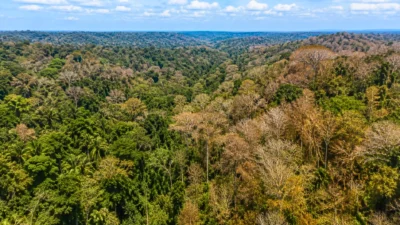
For this reason, natural forests still hold an advantage over the long term. Their growth, while less explosive, tends to be steadier, more diverse, and more robust against disturbances. They store carbon in a sustainable way and support a biodiversity that no standardized plantation can truly replicate.
This study from China delivers a timely message to climate policymakers. Many models still treat forests as a monolithic category, despite the reality that not all reforestation efforts are equal. A young, well-maintained, and monoculture plantation does not offer the same benefits or risks as a natural forest or spontaneous regeneration.
Ultimately, the fascination with China’s green wall lies less in its billions of trees and more in the questions it raises. In a world obsessed with numbers, it is no longer sufficient to count planted trunks or re-greened hectares. It is crucial to understand the quality of the forests we create for the climate, their longevity, biodiversity, and resilience as conditions become harsher.