
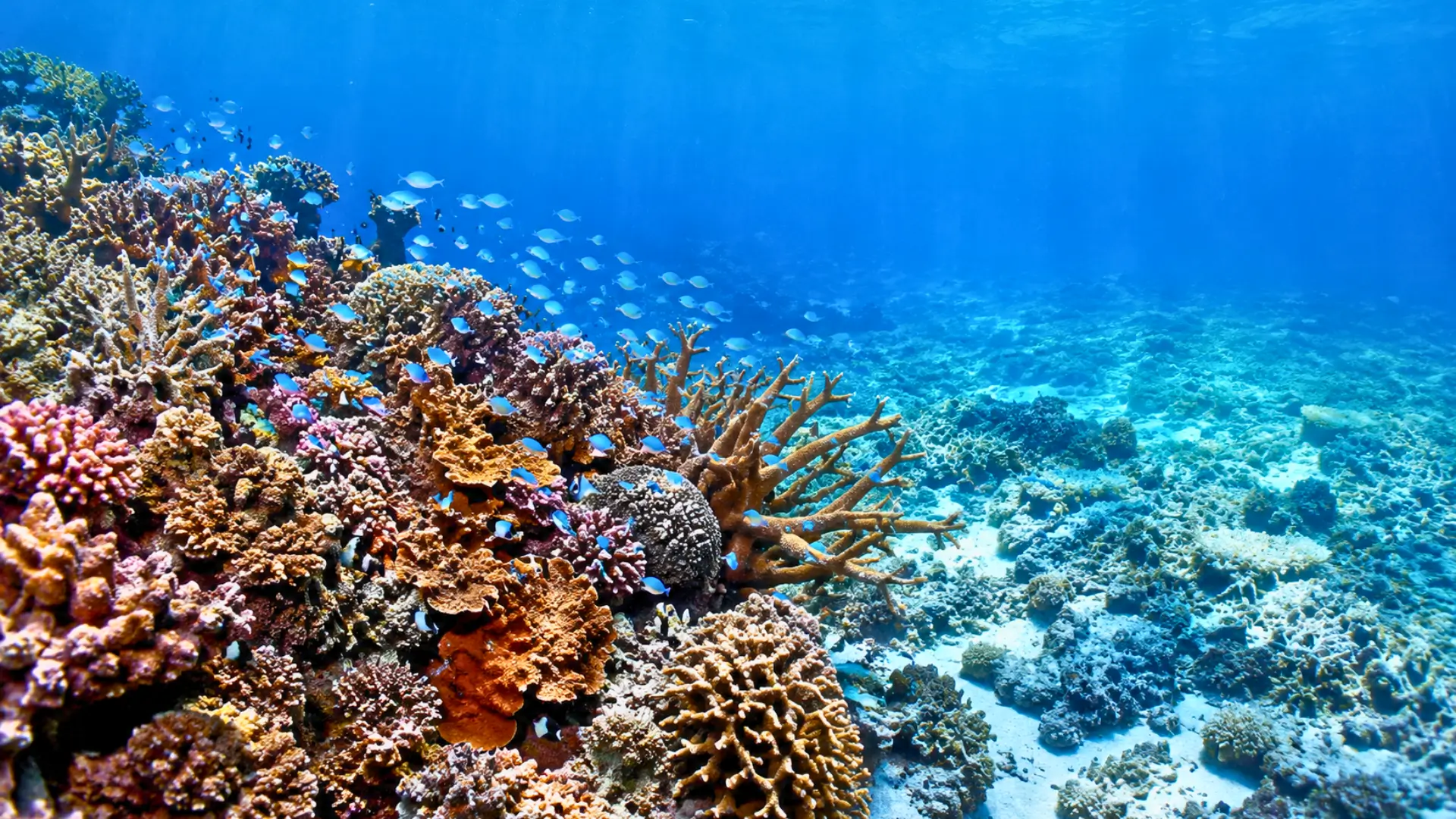
Under the sea, a healthy reef generates sounds comparable to those of a tropical rainforest. However, when this symphony fades, young fish lose their way. Could this unexpected silence hinder the recovery of the most vulnerable corals?
A rich soundscape under the surface
At first glance, a reef might seem quiet. However, diving in with a hydrophone reveals a vibrant world of clicks, grunts, and vibrations. The main contributors to this symphony are snapping shrimp, whose claws create microscopic bubbles that collapse dramatically, producing a sound similar to sizzling oil.
Fish also contribute their own surprising sounds. Some grunt to defend their territory, while others pulse during mating. This acoustic signature varies depending on the species, time of day, and environmental conditions. A study in 2021 found that these soundscapes can serve as reliable indicators of the overall health of reefs.
Young fish use sound as a compass in the vast ocean
The journey of a reef fish begins as an exile. After hatching, its larva drifts offshore, carried by currents for several days. Once it can swim, it must find a tiny habitat in an immense ocean. A miscalculation could lead to life or death.
At night, light offers little guidance, and odor molecules dilute in the water. However, sound travels efficiently underwater. Experiments have shown that fish larvae and even coral can navigate towards the sounds produced by a reef long before they can see its features. Studies confirm that this acoustic orientation is crucial for the survival of young aquatic life.
This attraction plays a role in larval recruitment, the time when newcomers select their future homes. Therefore, a reef is not merely a shelter or a food source. It also broadcasts a long-distance message: here, life thrives, hiding places exist, and other organisms have already succeeded.
The silence of damaged reefs triggers an invisible vicious cycle
When a heatwave causes a mass bleaching event, the transformation is not solely visual. Fish abandon degraded areas, invertebrate communities shift, and the biological buzz diminishes. As the reef loses its inhabitants, it becomes less acoustically attractive, akin to a city where all the lights go out at once.
The trap then closes. Reduced sound dampens the attraction for young fish, resulting in fewer herbivores to combat algae that compete with corals. The reef receives fewer reinforcements precisely when it needs them most. Degradation thus creates the conditions for its own acceleration, a phenomenon observed in various marine ecosystems.
Underwater speakers aim to revive silent reefs
In 2019, researchers positioned speakers near degraded reefs in the Great Barrier Reef. The experiment, published in Nature Communications, involved broadcasting the sounds of healthy reefs for several weeks. The results were surprising: the sound-enriched areas attracted twice as many fish, with a significantly higher species richness.
This approach, known as acoustic enrichment, cannot magically restore corals. However, it can complement transplantation efforts, regulate fishing, or support the installation of artificial structures. A study in Royal Society Open Science also found an increase in coral larval settlement when exposed to restored soundscapes.
Yet, one crucial limitation remains: attracting animals to a still-polluted or overheated habitat is not enough. Speakers may help bring life back, but they cannot cool the ocean. They highlight an often-overlooked aspect of ecological restoration: to rebuild a reef, must we also recreate its music?



