
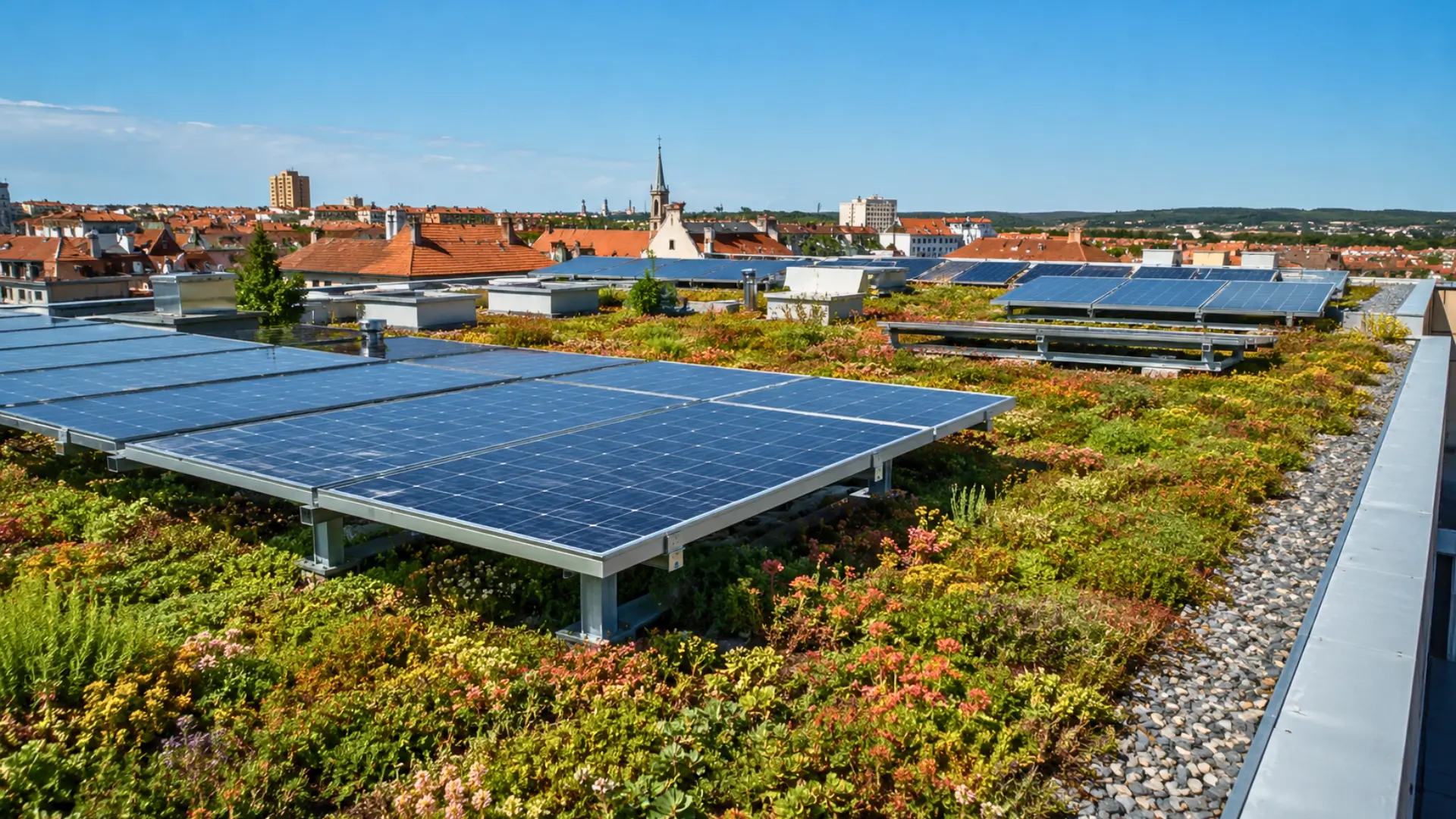
On might expect solar panels to thrive during sweltering summer days, but surprisingly, their performance can actually decline during heatwaves. What if the solution lies not in high-tech cooling systems, but rather in a blanket of plants?
Summer heat diminishes solar efficiency long before temperature records are set
At first glance, the relationship seems straightforward. More sunlight should mean more energy production from solar panels. However, during the sweltering days of July, beneficial sunlight is often accompanied by detrimental heat. Photovoltaic cells thrive under radiant energy but struggle with overheating, which disrupts their efficiency and diminishes expected gains.
The standard reference temperature for solar panels is around 25°C. Beyond this threshold, power output begins to decline. According to the International Energy Agency, solar performance is directly related to module temperature. For many silicon-based panels, efficiency can drop by approximately 0.3 to 0.5 percent for each additional degree Celsius.
On a dark roof, temperatures can escalate dramatically. Even if the air temperature is merely 30°C, the surface temperature of the panels can increase substantially. Poorly ventilated modules can reach dangerously high temperatures, as noted by the National Renewable Energy Laboratory, which can reduce both immediate output and the long-term lifespan of the components.
A green roof cools and protects panels from overheating
This leads to a surprisingly effective solution. Instead of relying on mechanical cooling for solar panels, some projects focus on the entire roof. A green roof serves as a living buffer. It not only limits the heating of the underlying membrane but also retains less heat in the materials and cools the air just beneath the panels.
The most intriguing mechanism at play is known as evapotranspiration. Plants absorb water and release some of it as vapor. This process consumes thermal energy, effectively cooling the surrounding air. The Environmental Protection Agency notes that a green roof can be up to 31°C cooler than a conventional roof.
Biosolar roofs enhance resilience against summer heat
In recent years, the collaboration between solar panels and vegetation has evolved from theoretical concepts to practical urban planning. Known as biosolar roofing, this approach does not aim to transform rooftops into elaborate jungles but rather to install hardy, low vegetation that can withstand wind, drought, and partial shade created by the panels.
Plants like sedum, drought-tolerant grasses, and creeping thyme are commonly selected. These plants require minimal substrate and maintenance while also protecting the roof from extreme temperature fluctuations, retaining rainwater, and providing a habitat for pollinators. This creates not merely a thermal enhancement but a functional micro-ecosystem.
Research from the University of Technology Sydney has shown that this partnership can also enhance energy production during hot periods. Various studies suggest potential increases in efficiency of a few percentage points, depending on local climate conditions, irrigation, panel height, and roof type. It may not be revolutionary but offers noticeable advantages as heatwaves become more frequent.
Combining vegetation and solar energy addresses the challenges of increasing heat
This approach is appealing because it addresses multiple challenges simultaneously. In urban areas, rooftops tend to trap heat and contribute to the formation of urban heat islands. A green roof can mitigate this effect, while solar panels generate local electricity just when demand for air conditioning spikes. Two distinct solutions converge within a small footprint.
A biosolar roof requires a compatible structure, reliable waterproofing, and suitable plant species. Its design must also ensure that the panels receive adequate light. However, as heatwaves become more common, this method exemplifies a subtle shift in modern engineering. By mimicking natural systems, technology can become more resilient. On the roofs of the future, energy efficiency might just thrive amid the plants.



