In one of the world’s busiest seas, scientists are now tracking invisible life without nets, trawlers, or diving. Their tool? Just a few liters of seawater. What they uncover could transform how we monitor the impact of future wind farms.
The English Channel: an emerging wind farm in a little-known sea
The English Channel is often perceived as a familiar geographical feature. However, beneath its surface, which witnesses 20 percent of the world’s maritime traffic, knowledge remains incomplete. This gap is particularly evident regarding the fish and crustaceans that inhabit it. Thus, the paradox of this heavily trafficked sea lies in its still-partially mysterious ecosystem.
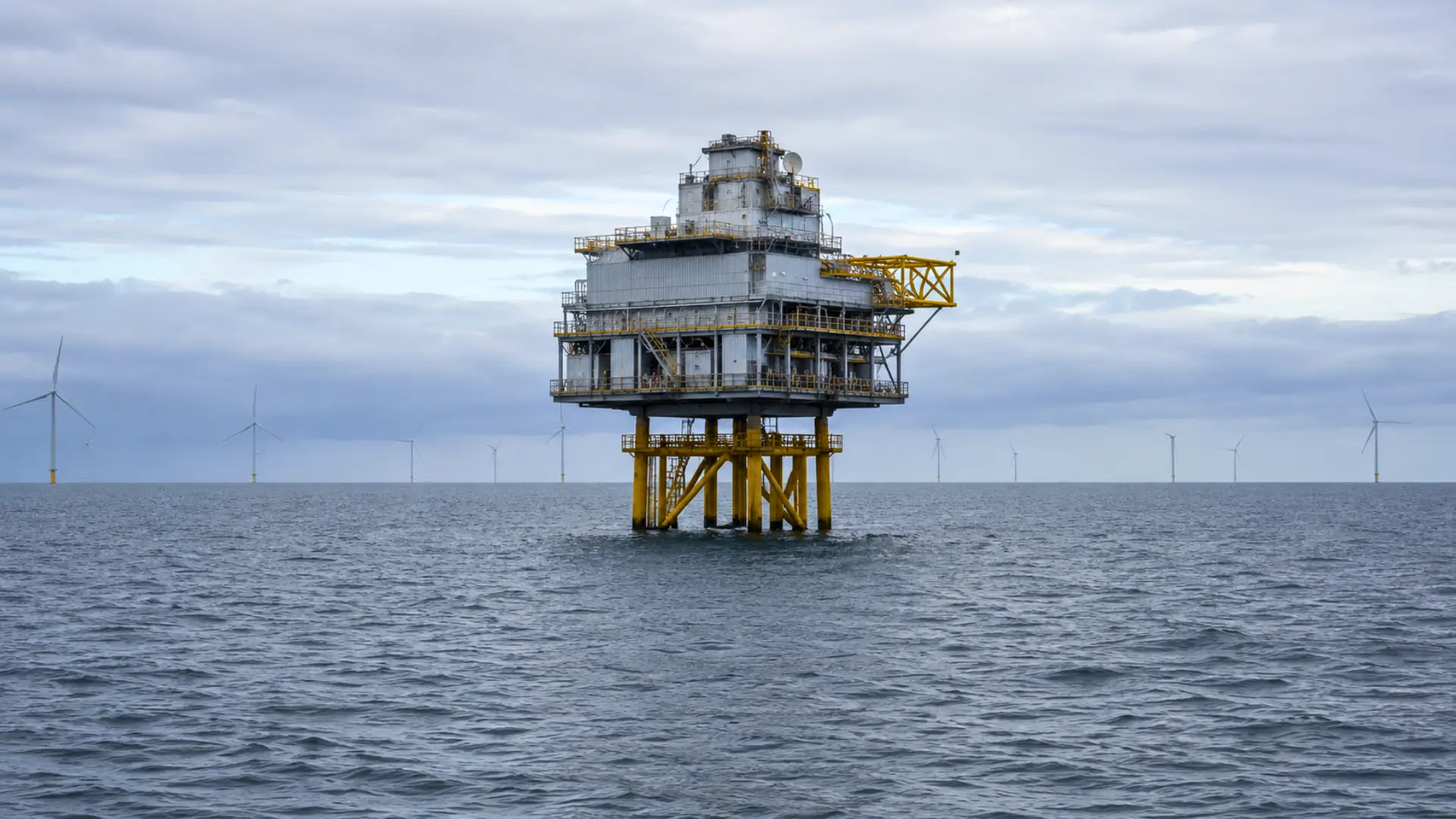
Within this already complex landscape, the upcoming Normandie wind farm project aims to install 37 to 47 wind turbines by 2032. The energy promise is clear, but a more delicate question lingers: what happens to marine species as such infrastructures become permanent fixtures in their environment?
This is where the Biodivmanche project comes into play, coordinated by Noémie Coulon, a postdoctoral researcher at the Marbec laboratory in Montpellier. Over four years, the team will compare various areas: exploited regions, construction sites, exploration zones, and control sites. The clear objective is to understand how biodiversity reacts before, during, and after the wind turbines arrive.
Environmental DNA helps catalog marine species without disturbance
The method chosen is fascinating and almost surreal. Instead of capturing animals, scientists collect the environmental DNA they leave behind in the water. This fleeting signature allows for the detection of rare, elusive, or protected species that often escape traditional surveys.
This approach transforms the observational landscape. It is no longer about forcing encounters with living organisms but about letting the environment tell its own story. During this year’s campaign, 101 filters were deployed across about thirty sites. Meanwhile, measurements of temperature, salinity, and depth connected species to their habitats.
Fuchsia underwater robots gather data from the depths
On the boat, the sight of the equipment is striking. In large black cases, small, streamlined machines in vibrant fuchsia wait, seemingly straight out of a sci-fi movie. These Autonomous Underwater Vehicles (AUVs) follow programmed routes and collect data close to the ocean floor.
Several times a day, these torpedoes dive, vanish, and return with a wealth of information that is invisible to the naked eye. This scene encapsulates modern science. While it may lack the drama of heroic expeditions, it is also more nuanced, patient, and incredibly effective for observing without disturbing the environment.
The ship itself represents another evolution. To minimize the mission’s carbon footprint, the team collaborates with the cooperative Skravik. They travel aboard the Morskoul, a 14.5-meter sailing catamaran. Even marine energy research is now striving to lessen its own environmental impact.
Wind farms: potential refuge or disruption for marine life
Preliminary results indicate a complex scenario. On one hand, wind farms could become areas of reduced human pressure, potentially offering some species a relatively protective role. On the other hand, they may disrupt other marine animals, especially rays and sharks, which are sensitive to electromagnetic fields produced by underwater cables.
This mix of hope and uncertainty is the essence of Biodivmanche. The project does not merely seek to count species but also to understand which species thrive, which decline, and the context behind these changes. The findings will be published on an online mapping platform, illuminating the challenging coexistence between energy transition and living ecosystems.
As the ocean transforms into a strategic space for producing decarbonized electricity, the need for careful observation emerges. It is crucial to monitor before development, measure before making assertions, and reveal what has long been invisible. In the English Channel, a few traces of DNA now remind us that the sea is never empty, even when it appears completely tamed.