
Planting millions of trees seems like an obvious solution to combat desertification. However, in the Sahel region, a subtler approach is making a significant impact: awakening roots that are already present in the soil. In some landscapes, these “invisible” trees hold a considerable advantage.
The green wall was meant to block the desert, but its mission has shifted
Initiated by the African Union in 2007, the concept was ambitious. The Green Wall was designed to stretch over 8,000 kilometers, from Senegal to Djibouti. This green belt aimed to restore degraded land in the Sahel while also offering protection from drought, erosion, and climate change.
However, planting trees in such landscapes is no easy task. Young saplings must endure irregular rainfall, intense heat, and grazing animals. The soil can be exceptionally barren. Consequently, the original vision has evolved. The “wall” now takes the form of a mosaic of restored lands, incorporating crops, pastures, and improved water management.
Beneath arid fields, long-cut trees can still be alive
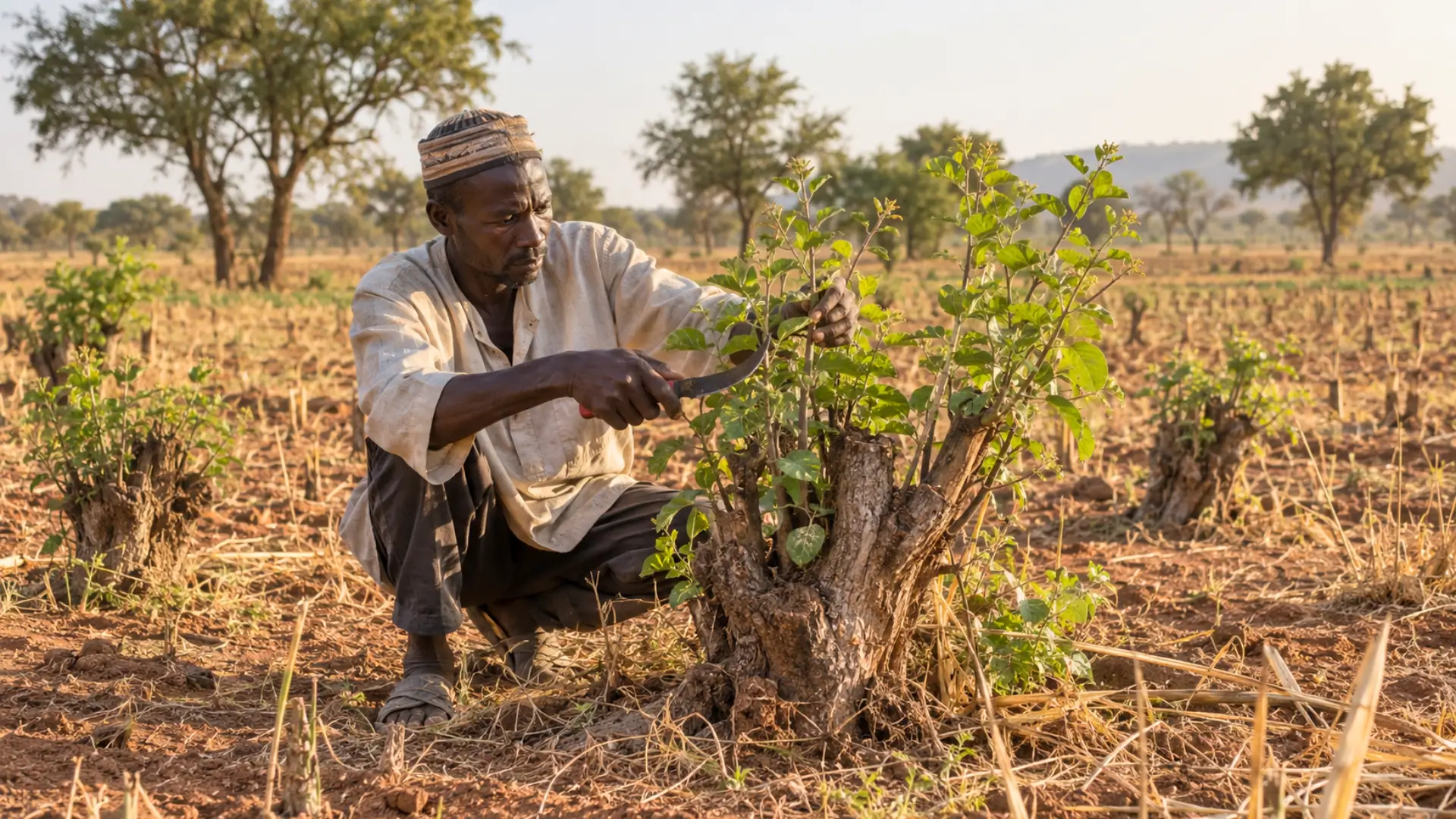
The real surprise often lies just below the surface. In some Sahelian fields, a seemingly dead stump may harbor a living root network. This network can produce new shoots. Thus, the tree hasn’t completely vanished; although its visible part is absent, the foundation remains active underground.
Assisted natural regeneration focuses on selecting these shoots. They then need to be protected and pruned to enhance their growth. This method, while appearing modest compared to large-scale planting campaigns, often yields better survival rates. It is also less costly when the terrain is suitable.
The advantage lies largely in what remains invisible. A nursery sapling must first establish its roots, while a regenerated tree already has a root system in place. It also comes from a species adapted to the local climate. In Niger, this approach has fostered agroforestry systems, which help reduce erosion and minimize water evaporation.
Protecting a shoot in a field can yield more than planting a tree elsewhere
This biological difference quickly translates into economic benefits. Growing a sapling requires time and resources -it must be transported, planted, and watered. In contrast, assisted natural regeneration makes use of existing plant capital. Farmers can manage this with simple tools.
The benefits extend beyond the number of trees. Their shade cools the soil, their leaves contribute organic matter, and their roots strengthen soil stability. This agroforestry integrated with crops allows for land restoration without dedicating entire plots to forest. It thus protects both crops and the livelihoods of families.
The lesson from the Sahel is not to stop planting, but to first observe what survives
It’s important not to see this method as a one-size-fits-all solution. In areas of severe degradation, natural regeneration may be slow or even fail. The FAO recommends local seeds, soil preparation, and water retention techniques in such cases.
This complexity is what makes the Green Wall more intriguing than just a simple line of trees. By 2026, its partners aim to combine land restoration with livelihood strategies. Burkina Faso and Niger are among the affected countries. However, the UNCCD notes that progress is hard to measure across the board.
The revolution, therefore, is less about planting rows of young trees in the sand and more about observing each terrain before acting. It involves planting here, retaining water there, and protecting wherever life is already beginning to return. What if the restoration of an ecosystem starts by uncovering what still refuses to die?



