The gray bins in France have never been lighter. Yet, just outside Paris, a massive industrial project has been underway since 2018. How can we explain the continued investment in incineration when waste disposal is sharply declining?
In Ivry, a giant built in 1969 is making way for a completely rebuilt plant
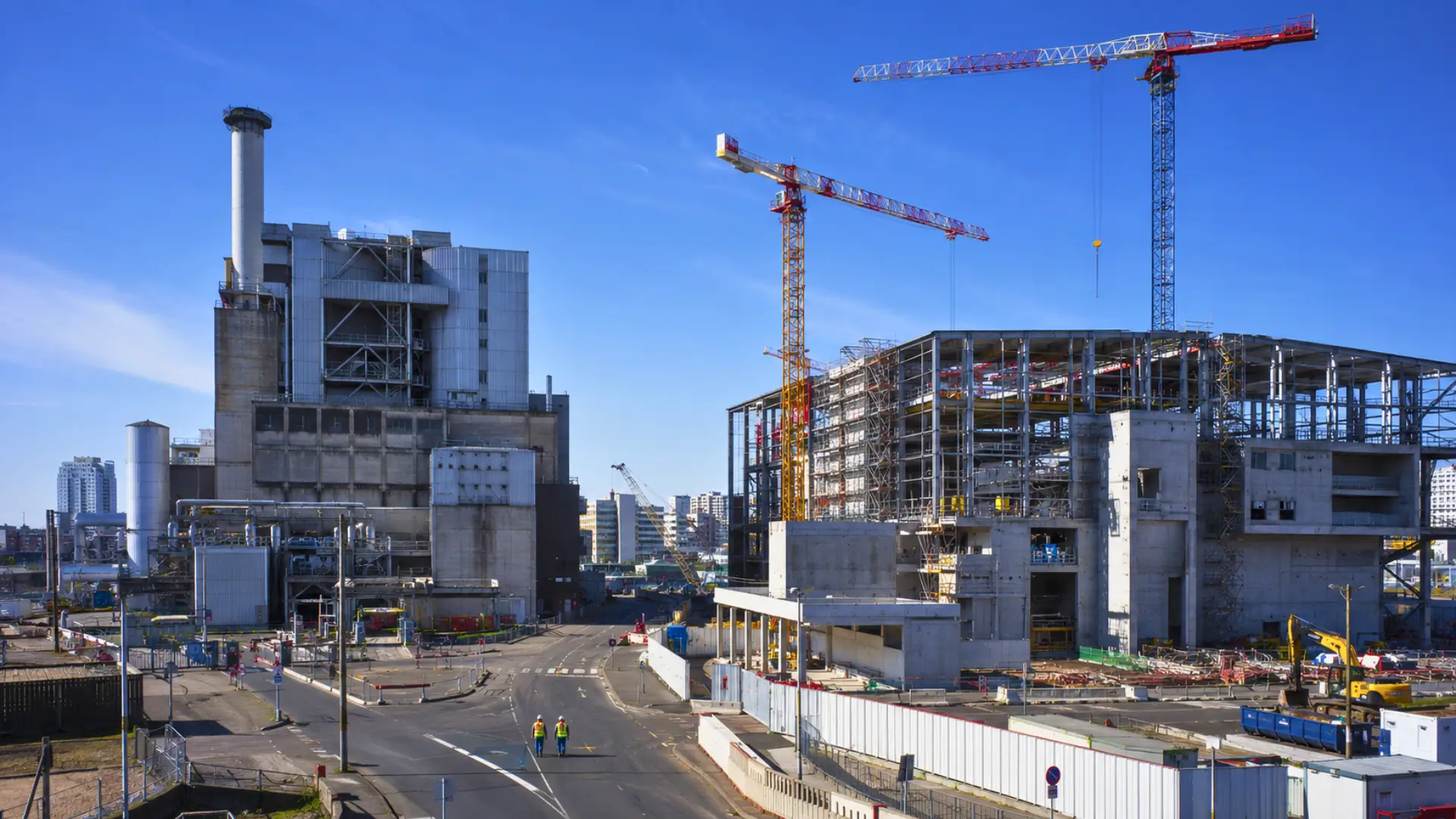
On the fringes of Paris, the landscape resembles a scene from an old industrial film. The Ivry-Paris XIII incinerator has been operational since 1969, processing waste from a population of around 1.4 million people. After numerous upgrades, the facility is now nearing the end of an unusually lengthy operational life for such equipment.
Its successor, named L’Interval, began construction in late 2018. A striking feature of this project is that the new facility is being built almost alongside the old one, which must continue functioning throughout the construction phase. This complex industrial arrangement partly explains the difficulties and delays reported by Syctom, the managing authority.
The initial launch date, once anticipated to be much earlier, has now been pushed back to no later than November 2026, as announced by Syctom. An incident during testing in 2025 has notably disrupted the timeline. In the meantime, the historical plant continues to burn waste, even after surpassing fifty-five years of service.
While the project progresses, the waste generated by the French is decreasing significantly
This is where the narrative becomes truly intriguing. According to the ADEME’s MODECOM 2024 campaign, the average French person produces just 223.5 kg of residual household waste each year. This marks a decline of 172 kg per individual since 1993, translating to about a 44 percent reduction. Over the past few decades, the fuel needed for incinerators has become increasingly scarce.
This drop in waste is not solely due to changes in consumer behavior. The expansion of yellow recycling bins, new recycling pathways, and the separation of organic waste are all leading to a gradual decline in what ends up in the gray bin. The potential for further reductions remains vast, as ADEME estimates that nearly seven out of ten items currently ending up in gray bins could be recycled or repurposed instead.
The new facility will burn half as much, and this detail completely changes the debate
The most telling figure comes from Syctom itself. The old site could handle around 700,000 tonnes of waste per year, while L’Interval will limit its capacity to just 350,000 tonnes, effectively cutting incineration capacity in half. Designers have scaled down the new facility to directly account for the expected decrease in residual waste.
This reduction in scale challenges the image of ever-expanding incinerators. However, it raises further questions: how much lower can waste volumes go? From 2017 to recent national data, residual waste has already dropped from 252.7 to 223.5 kg per person. This trend is far from trivial.
This ongoing decline has fueled criticism from zero waste advocacy groups for years. As early as 2015, the alternative plan known as B’OM advocated for a focus on prevention, organic waste, and improved sorting, with a budget proposed at 200 million euros. While a grassroots initiative, it reveals a significant model choice.
Behind the tonnages and millions, the real battle now concerns what should be burned
Incineration still holds a compelling argument: it does not merely eliminate waste. In Ivry, the heat produced generates steam used for the Paris heating network and contributes to electricity generation. Rapidly replacing this capability will require careful consideration of waste management, energy production, and remaining treatment options.
However, another reality complicates the picture. In 2024, gray bins still contained 32 percent organic waste and 27 percent paper or packaging that should ideally be recycled. This means that a significant portion of what could theoretically feed the incinerators tomorrow no longer needs to be incinerated.
L’Interval could thus become a symbol of a peculiar transition: a new plant, designed to last for several decades, set against a society that aims to reduce what it burns. The question may soon shift from whether the incinerator is large enough to how long the 350,000-ton capacity will still be necessary.