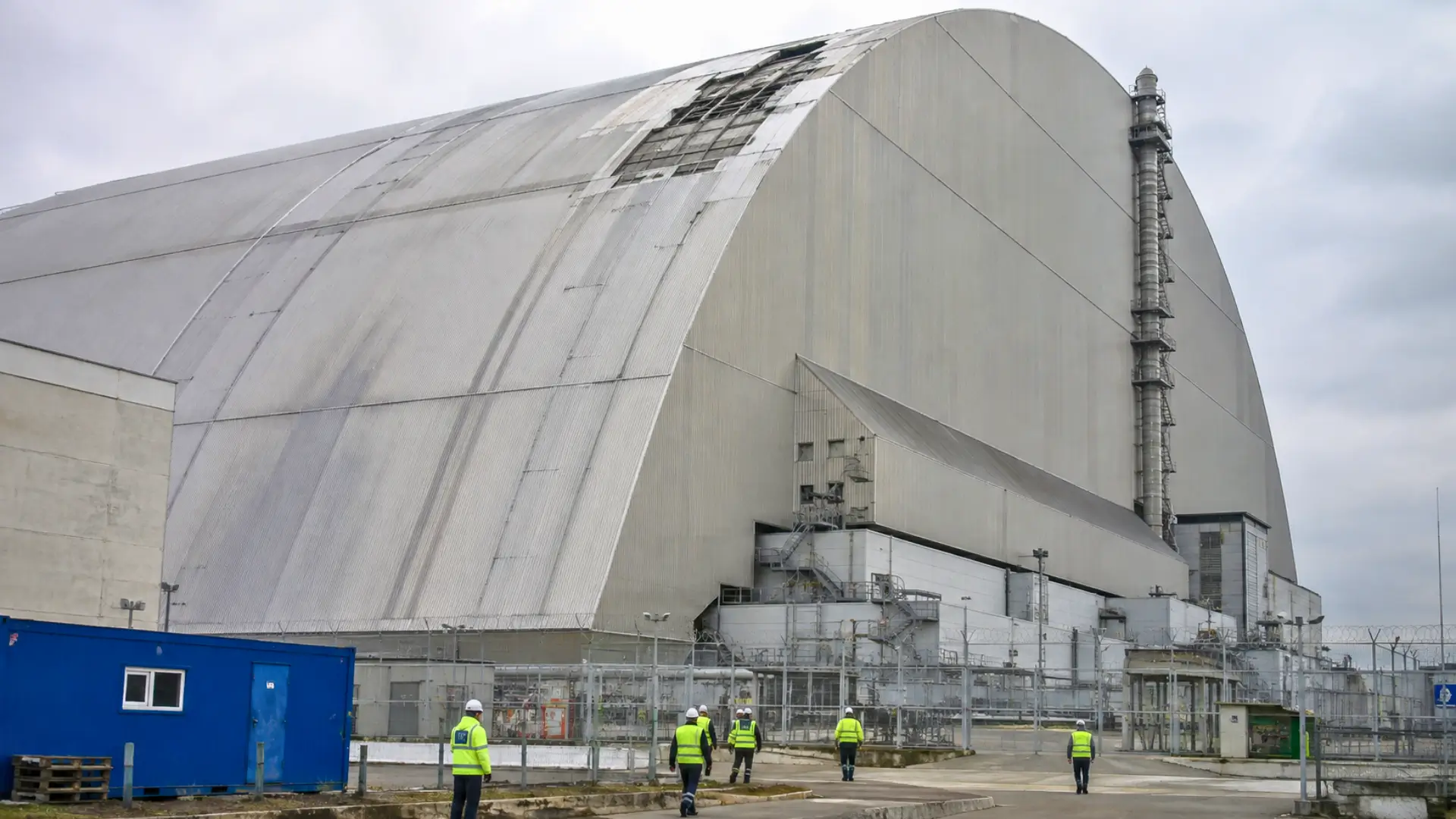
Standing 108 meters tall and weighing 36,000 tons, the Chernobyl containment arch was designed to protect Reactor No. 4 for a century. Yet, less than a decade after its installation, a drone struck the massive structure. How do we safeguard a nuclear disaster for multiple generations?
The construction journey of the Chernobyl arch
Building a steel cathedral right over a shattered reactor is not feasible. To minimize worker exposure, engineers constructed the new Chernobyl containment structure at a safe distance, over a decontaminated area. Its dimensions are impressive: standing at 108 meters high, 162 meters long, and spanning 257 meters.
In November 2016, the arch commenced its journey towards Reactor No. 4. A system of 224 hydraulic jacks moved it in 60-centimeter increments. After covering 327 meters, it reached its final position. The European Bank for Reconstruction and Development still regards this as one of the largest mobile terrestrial structures ever built.
The aftermath of the 1986 accident remains unresolved
The arch does not erase the existence of Chernobyl. Instead, it encapsulates the remnants of the destroyed reactor from the catastrophic explosion on April 26, 1986, and the original hastily erected Soviet sarcophagus. According to the European Bank for Reconstruction and Development, around 200 tons of highly radioactive materials are still contained within this site.
The original shelter was deteriorating dangerously due to cracks, corrosion, and water infiltration. The new arch had two main purposes: to limit the spread of radioactive dust and to facilitate the gradual dismantling of the initial sarcophagus using remote-controlled equipment located beneath the arch.
Moreover, even the air quality inside is closely monitored. A ventilation system maintains low humidity levels to slow down the corrosion of the steel. The projected century of operation is not an indication of vanishing radioactivity, but rather an opportunity for teams to carry out essential tasks over generations.
An international investment for a century of security
Constructing this metallic shell cost approximately 1.5 billion euros. The overall international safety program for the reactor exceeded two billion euros. Forty-five countries and institutions funded the arch’s construction, coordinated by the European Bank for Reconstruction and Development, which played a crucial role in the project.
This mobilization tells a different story about Chernobyl. Even thirty years after the disaster, the implications extended far beyond Ukrainian borders. By July 2019, authorities officially took charge of the arch, its cranes, surveillance systems, and technical installations. The spectacular project was nearing completion, but nuclear management was simply transitioning to a new form.
On February 14, 2025, however, a drone strike damaged the containment shell. Inspections revealed a breach of about 15 square meters, along with damage to the coating and several pieces of equipment. Despite the fire, available measurements indicated no significant degradation in the radiological situation around the site.
The drone strike in 2025 highlights ongoing vulnerabilities
The real issues arise over the long term. The European Bank for Reconstruction and Development explained that the impact had affected several systems essential for maintaining the expected lifespan of the arch. Emergency repairs were initiated, with costs projected to exceed 100 million euros. In 2026, international partners approved new studies and preparatory operations.
The current objective is to fully restore the arch’s functions by 2030. However, this timeline shifts our perception of this monumental structure. Engineers had designed it to withstand cold, corrosion, and extreme natural phenomena. Yet, the war imposes a threat that they had not factored into their scenarios.
Even when repaired, the arch serves merely as a temporary solution. Over its century of operation, teams will need to dismantle, sort, monitor, and secure the materials lying underneath. Chernobyl now spans generations; when this colossal vault eventually reaches the end of its life, what will need to be built to continue the safeguarding process?