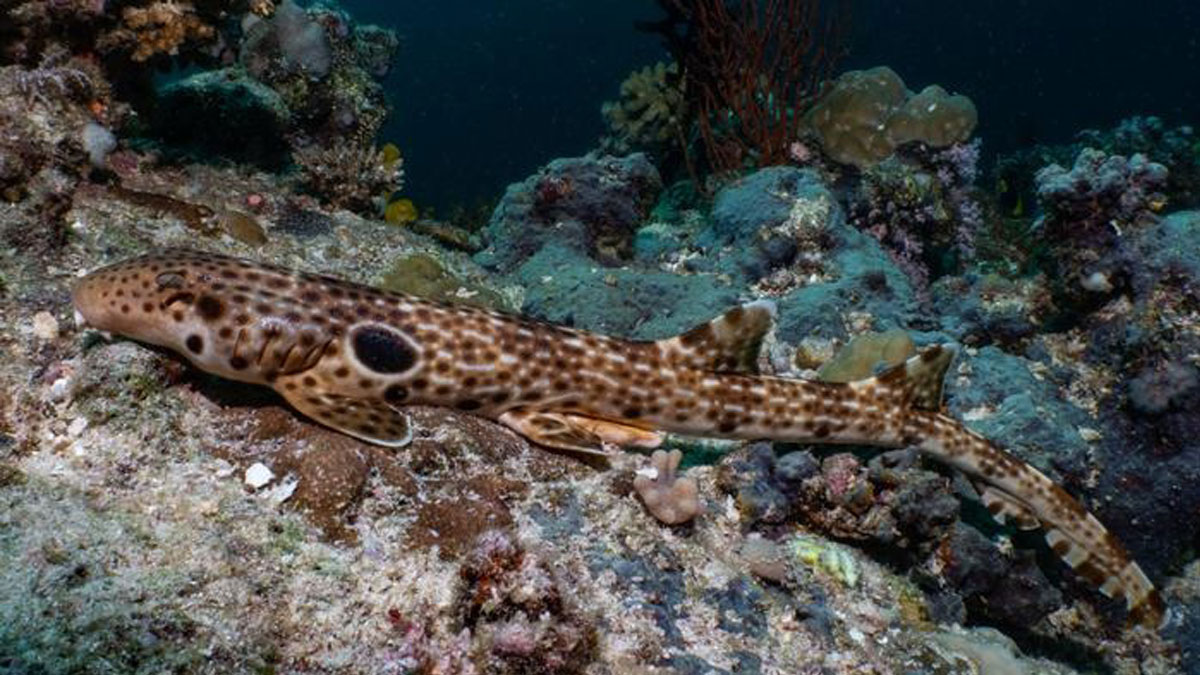
Although locals have long been aware of its presence, a recent scientific expedition along the coast of Papua has led to the description of a new species of walking shark, the tenth officially recognized.
Hemiscyllium dudgeonae
The species in the Hemiscyllium genus, commonly known as walking sharks or epaulette sharks, are remarkable for their ability to use their pectoral fins like legs. This adaptation allows them to waddle along the ocean floor and shallow reef flats during low tide, primarily feeding on small invertebrates.
Named Hemiscyllium dudgeonae, the new species was first spotted in March 2025 in less than a meter of water in Milne Bay, known for its seagrass meadows. Christine Dudgeon, the Australian scientist after whom the new species is named, explained that her team was originally searching for Hemiscyllium michaeli, which had been observed multiple times in the area.
Startled by the beam of her flashlight, the specimen, measuring about 75 centimeters in length, was gently captured by Dudgeon using a jiu-jitsu-inspired hold to quickly place it upside down, inducing tonic immobility. The shark was subsequently examined on board the research vessel.
“At first glance, it was evident that its color and patterns, reminiscent of those found on leopard sharks, were different from those of other known walking sharks with remarkably similar sizes and morphologies,” said Jess Blakeway, co-author of the study published in the Journal of the Ocean Science Foundation.

A new species in danger
In the following days, eleven additional specimens of H. dudgeonae were identified during dives, with samples taken from nine of them. Back at the lab, Dudgeon and her colleagues conducted a series of DNA sequencings to confirm that they had indeed discovered a new species.
According to Blakeway, rapid coastal development, the expansion of oil palm plantations, and episodes of coral bleaching are heavily impacting the walking shark populations in Papua New Guinea. The fact that H. dudgeonae exists only in Milne Bay suggests it may be the most endangered species among them.
“This new shark highlights the extraordinary biodiversity of the region, yet it could easily vanish without drastic conservation measures,” warns the researcher.
Previously, a species of shark thought to be extinct for half a century was rediscovered in the waters around Papua.