Though long perceived as a quiet ally of biodiversity, shade-grown coffee tells a more fragile story than it seems. A recent study conducted in Colombia reveals a decisive point: without nearby forests, even the most tree-rich plantations struggle to serve as refuges for birds.
Shade-grown coffee in Colombia: appealing but insufficient
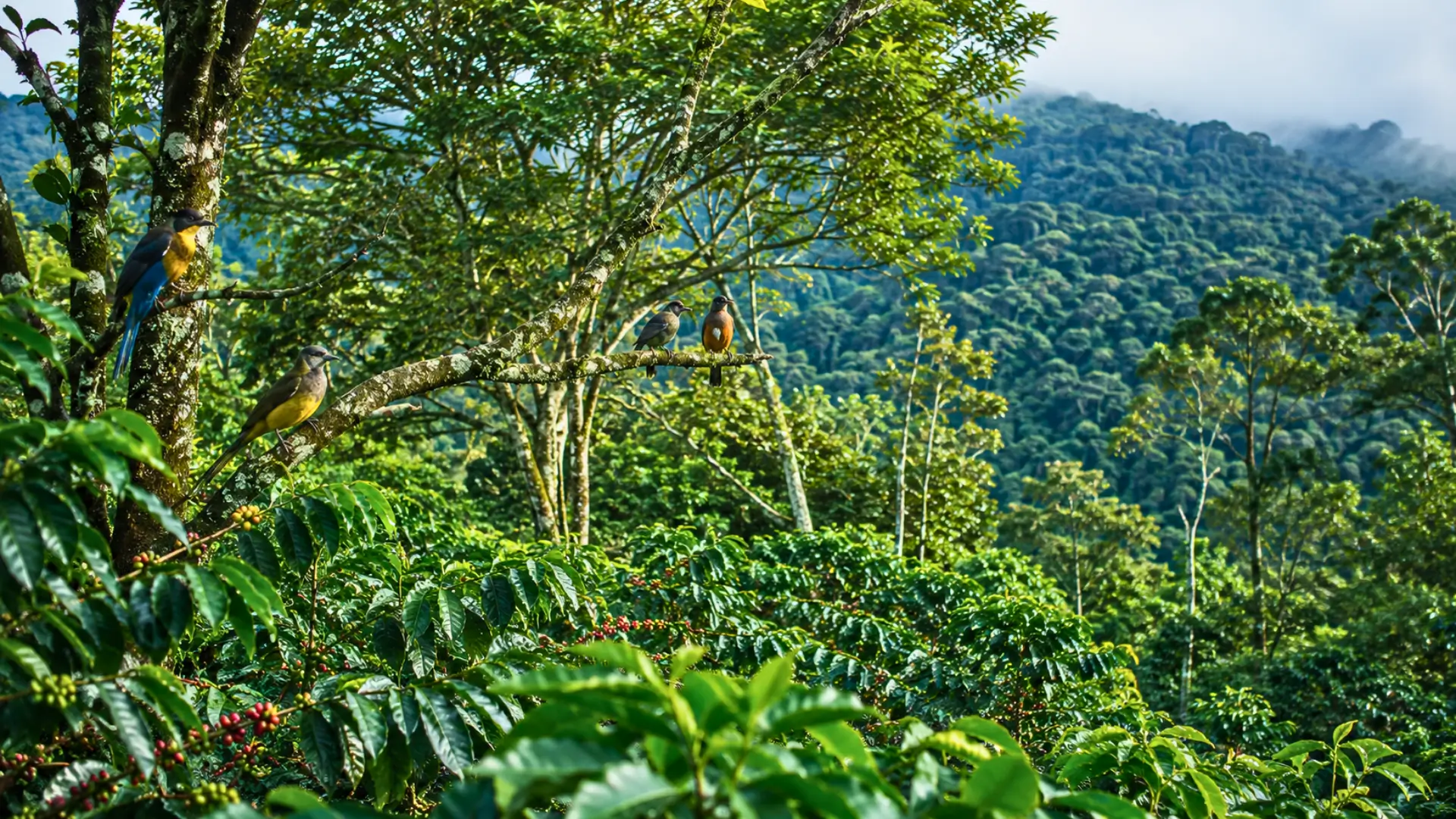
In ecological discussions, shade-grown coffee often comes across as a model of sustainable farming. It suggests cooler plots, perches for wildlife, varied vegetation, and an encouraging promise of agriculture harmonizing with nature. On paper, this image is attractive and almost comforting.
However, in the eastern Colombian Andes, researchers took a closer look. By comparing bird counts over two seasons in plantations and forested areas, they uncovered a less intuitive reality. The key factor was not just the farm itself, but the entire landscape surrounding it.
Bird populations depend heavily on nearby forests
Published in 2026 in the Journal of Applied Ecology, the study’s findings are clear. The greater the proportion of forest around the studied sites, the higher the chances that birds will occupy these habitats. The authors even demonstrated that having a forest cover within two kilometers serves as a strong predictor for avian presence.
This detail shifts the narrative significantly. A shade plantation can provide shelter, food, and some continuity of vegetation. Nevertheless, when surrounding forests decline, many species hesitate and subsequently vanish. Shade-grown coffee does not become irrelevant, but it ceases to be the miracle solution often portrayed in public discussions.
Forest-dependent species bear the brunt of this change. According to the study, such species require a landscape with more than 32 percent forest cover to maintain a moderate likelihood of habitat occupation. Below this threshold, the decline is steep and unsettling, marking a significant ecological shift.
Birds reveal the true state of biodiversity in coffee landscapes
Monitoring bird populations is not merely a naturalist’s hobby. Being high in the food chain, birds often serve as indicators of the overall health of ecosystems. When they abandon a landscape, it rarely signifies an inconsequential detail.
In coffee-growing regions, their presence indicates real balances in the ecosystem: better regulation of insects, stable pollination, richer plant diversity, and greater resilience to disturbances. In other words, the implications extend far beyond the conservation of a few colorful species. They touch upon the very stability of agricultural landscapes.
Shade-grown coffee is truly beneficial when adjacent forests thrive
The study does not undermine the model of shade-grown coffee. Instead, it shows that these plantations can materially benefit diverse species, particularly when the vegetation remains rich and varied. Some species even seem to thrive better when the plant structure is complex and less simplified by intensive agriculture.
The crux lies elsewhere: these advantages multiply in the presence of a surviving forest matrix. Researchers argue that in landscapes with shade-grown coffee, it is necessary to achieve 45 percent forest cover around farms to sustain certain sensitive species. Farms and forests do not substitute for each other; they strengthen one another.
This lesson extends beyond Colombia. Coffee remains, according to the FAO, the most commercially traded tropical product globally, with up to 25 million farming households representing 80 percent of the world’s production. As every cup of coffee is touted as a consumer choice, a broader question arises: how many birds can a plantation still support when the surrounding forest has already disappeared?