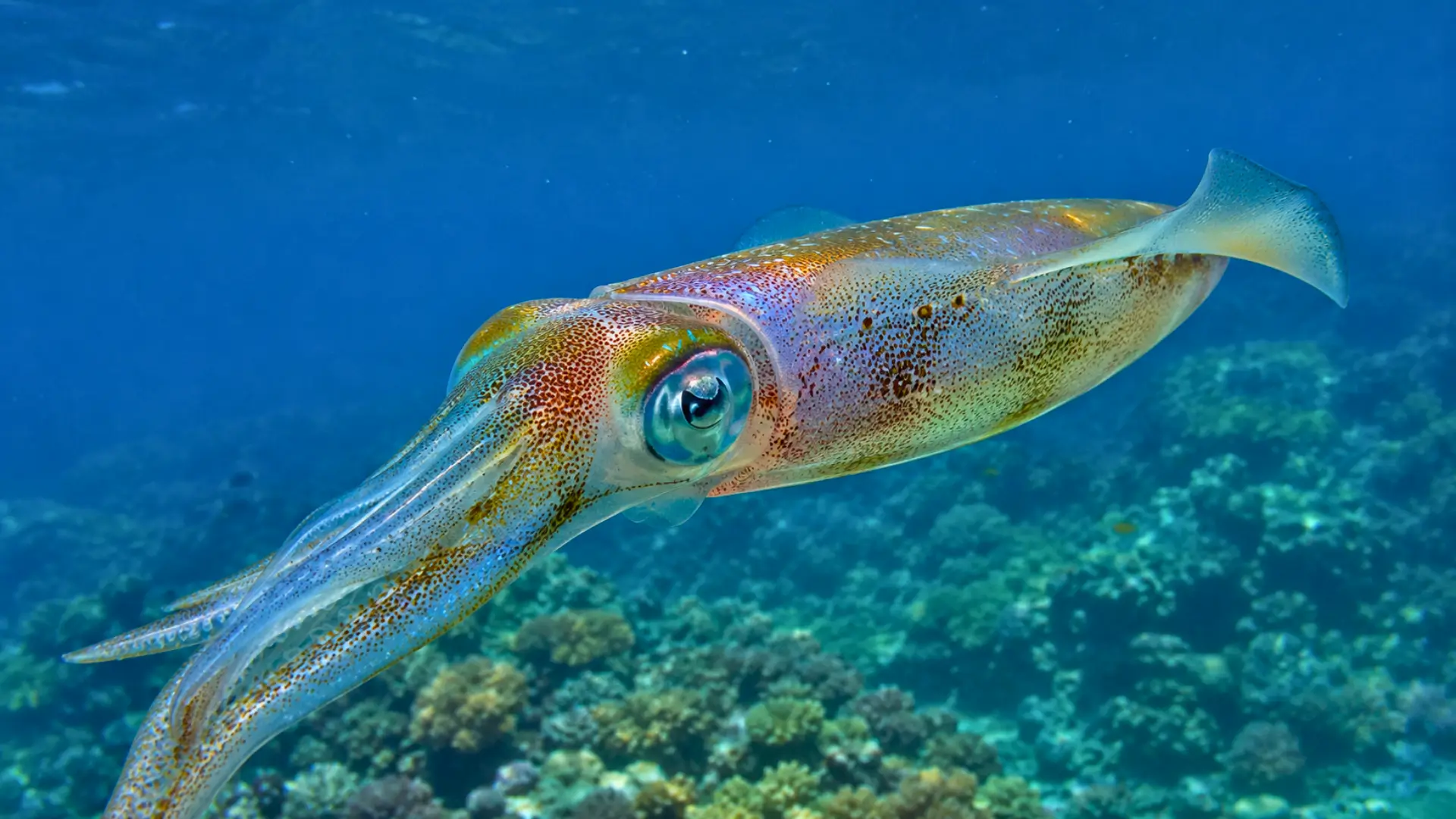
They see, remember, learn, and calculate their attacks in a fraction of a second. However, recent research suggests that ocean acidification might significantly shrink the brains of certain squids. What will become of these highly skilled hunters in the seas of 2100?
The remarkable intelligence of cephalopods revealed by their learning abilities
A crab trapped in a jar might seem out of reach. Not for a cephalopod. After some observation, an octopus can manipulate the lid with its suckers to access its meal. These skills highlight a surprisingly sophisticated intelligence capable of problem-solving, learning, and even anticipating outcomes.
Squids belong to this remarkable family of sea creatures. Their nervous system contains hundreds of millions of neurons spread across their brains and arms. In these swift predators, vision plays a central role: it allows them to spot prey, evaluate its trajectory, and launch an attack almost instantaneously.
A scientific experiment simulating future oceanic conditions
At Acadia University in Canada, researchers raised bigfin reef squids in two different environments. One simulated current ocean conditions with a pH of 8.2, while the other replicated a 2100 ocean scenario, where pH levels dropped to 7.8 due to CO₂ absorption.
This difference may seem trivial. However, the pH scale is logarithmic, which means that even a small shift can considerably alter water chemistry. The ocean absorbs about a quarter of human CO₂ emissions, which helps mitigate atmospheric warming but steadily increases acidification and disrupts numerous marine organisms.
After a 90-day exposure, the squids were examined using diffusion MRI, a technique that provides detailed imaging of brain tissues. The results initially resembled a computer error: in the squids exposed to acidified water, the average brain volume had decreased by around 49%. Their bodies, however, had not shrunk.
Marked reduction in the brain areas responsible for visual processing
Not all brain regions were affected equally. The areas involved in visual processing saw some of the most significant reductions. According to initial findings, certain structures may have lost up to nearly 62% of their volume. For a predator reliant on sight, this discovery is particularly alarming.
Previous research published in Communications Biology had already demonstrated that acidification alters the functioning of the optic lobes and significantly reduces predation behaviors. Squids exposed to higher levels of CO₂ attacked their prey less frequently. The issue seems to stem not from their eyes, but from the way their brains interpret the signals.
A less capable squid is not just at risk of missing its lunch. It may also become more vulnerable to predators such as tuna, sharks, seabirds, or mammals that hunt them. By weakening an essential intermediate predator, acidification could trigger cascading effects in ocean food webs.
Potentially significant consequences for marine ecosystems and their balances
Caution is warranted. These observations stem from a controlled experiment conducted on a specific species, and further peer-reviewed research is needed to strengthen conclusions about brain reduction. Researchers are now analyzing squids after 30 and 60 days to better understand when this phenomenon occurs during their development.
Several possibilities are being explored: oxidative stress, a lack of energy to grow the brain, or metabolic disruptions in neuronal function. No definitive explanation has emerged yet. However, the implications extend beyond fragile shells: climate change may affect the cognitive abilities of animals that once seemed well-adapted for survival.
The ocean in 2100 may not only be warmer, higher, or more acidic. It could become a world where some predators can still see their prey but fail to grasp what they are looking at quickly enough. In the ocean, mere seconds of hesitation can determine who survives to eat and who disappears.