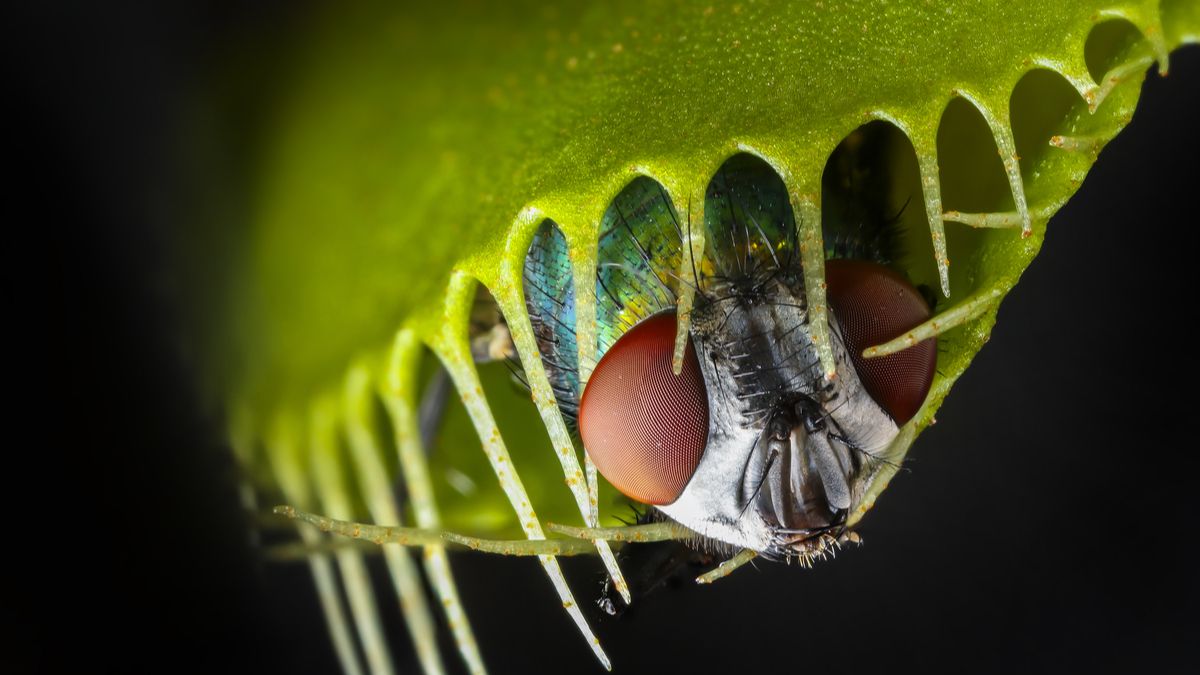
Recent experiments have shed light on the mysterious physiological mechanism that allows the jaws of a famous carnivorous plant to close in less than a second on their unsuspecting flying prey.
Snap shut
The Venus flytrap (Dionaea muscipula), with its intoxicating nectar, lures insects unsuspectingly into a deadly trap. The rapid closure of its jaws led Charles Darwin to hypothesize that these carnivorous plants must have some form of a nervous and muscular system. However, groundbreaking research published in the journal Science reveals a different story.
Yoël Forterre from CNRS and his team discovered that the quick “snap” of its jaws is due to the softening of surface cells. Forterre noted, “It was truly surprising that plant cell walls could alter their mechanical properties so quickly.”
To reach this conclusion, the researchers utilized a tiny metallic tip known as a nanoindenter to probe the outer surface of D. muscipula leaves, measuring pressure variations. The leaves had been carefully stabilized using dental glue to prevent the trap from closing.
“Upon contact with just a drop of water, it wouldn’t reopen until the following day,” he explains. “If it captures an insect, digestion and the breakdown of its exoskeleton would take weeks.”
It was widely thought that the movement of water through Venus flytrap cells caused the trap to close, but detailed experiments have led scientists to propose an alternative mechanism https://t.co/mSYVLTIauO
– New Scientist (@newscientist) June 15, 2026
Cellular softening
Previous research indicated that merely bending the filaments of the trap’s lobes triggered the rapid spread of an electrical signal across the jaws in less than a tenth of a second.
The latest findings point toward an almost instantaneous softening process at the cellular level, rather than the previously suggested “deflation” caused by the migration of water molecules.
“Plants are simply incredible,” enthuses Forterre, who has studied D. muscipula for two decades. “They can sense their environment, react, and even communicate with each other.”
In earlier studies, researchers described a plant that becomes carnivorous when deprived of a specific nutrient.