What if the bottles, bags, and containers mixed at the bottom of a trash bin could become a source of energy? Researchers have successfully converted three common plastics into hydrogen within the same reactor while capturing carbon in solid form.
The global recycling challenge amidst rising plastic waste
The yellow recycling bin can give a false sense of assurance. Many might think the problem of plastic waste is close to being solved, but the reality is much bleaker. A study published in Science Advances estimates that a mere 9 percent of plastic waste produced up to 2015 was recycled, with the rest ending up incinerated, buried, or abandoned in nature.
Recent data from the OECD reinforces this troubling trend. In 2019, only 9 percent of plastic waste was recycled. Sorting remains a significant barrier, as mixed, soiled, or multi-layered polymers complicate industrial valorization and slow down treatment processes.
An innovative process capable of treating multiple plastics without prior sorting
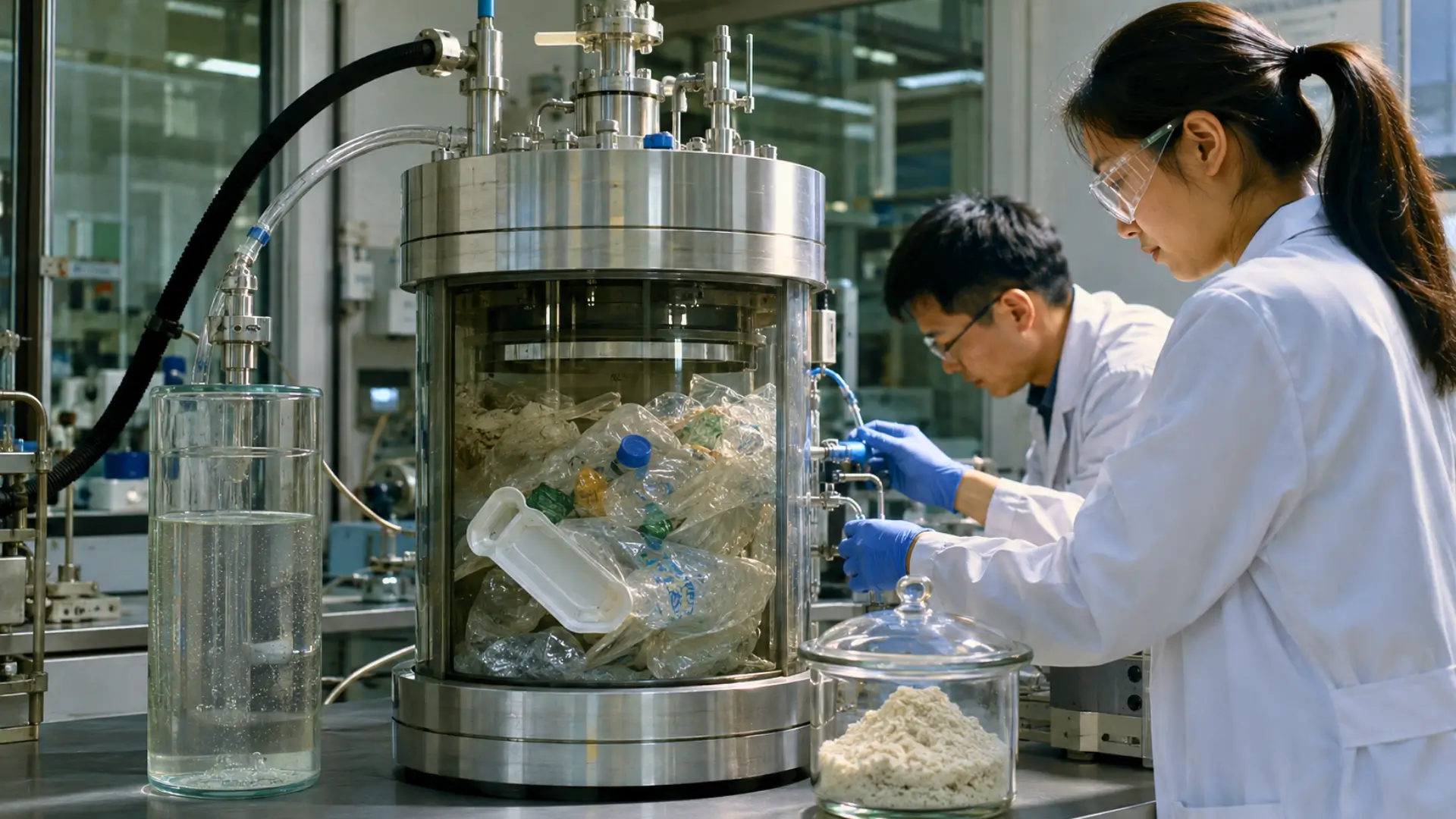
Against this backdrop, a team of American and South Korean researchers claims to have overcome this hurdle. Their method, described in the Proceedings of the National Academy of Sciences, treats PET, polyethylene, and polypropylene together -materials commonly found in our bottles and packaging. Importantly, no sorting by polymer type is required before the reaction.
They named their method alkaline thermal treatment (ATT). Within the reactor, the plastics are heated with sodium hydroxide. This process transforms the materials into several products, with a gas containing over 90 percent hydrogen, according to their findings.
Additionally, carbon does not escape as carbon dioxide. Instead, the process captures it in solid compounds, including sodium carbonate. While this does not guarantee total carbon neutrality, the carbon capture occurs directly during the reaction.
Chemical challenges due to the resistance of polyethylene and polypropylene
On one hand, PET reacts quite easily due to its structure, which contains bonds sensitive to chemical treatment. In contrast, PE and PP are more resistant. Their long chains of carbon and hydrogen offer few points of attack, making these highly stable polymers difficult to react in alkaline conditions.
To address this challenge, scientists introduced a critical step by exposing the plastics to moderate thermal oxidation. This treatment creates oxygenated groups on the molecular chains, which generate new reactive sites that facilitate the action of sodium hydroxide on PE and PP.
Furthermore, the process operates at much lower temperatures than some traditional techniques, thereby reducing energy requirements. However, its efficacy will depend on pre-treatment, product recovery, and the management of reactants at scale.
A promising technology facing challenges for industrial scaling
Nevertheless, engineers will face several challenges. Real-world waste contains dyes, adhesives, and food residues, and also includes plastics that were not part of the study. Therefore, evaluating the cost of sodium hydroxide, equipment lifespan, and the value of the solid residues generated will be essential.
Moreover, this technology should not replace efforts to reduce waste. It does not eliminate the need to improve mechanical recycling. However, it could provide a solution for difficult-to-treat mixtures. The United Nations Environment Programme warns that without strong action, plastic waste could triple by 2060.
Ultimately, an intriguing perspective emerges. The least valuable waste could fuel industrial processes or fuel cells. While the trash bin won’t become clean, it could cease to be a dead end. Will transforming waste into hydrogen change our relationship with plastic?