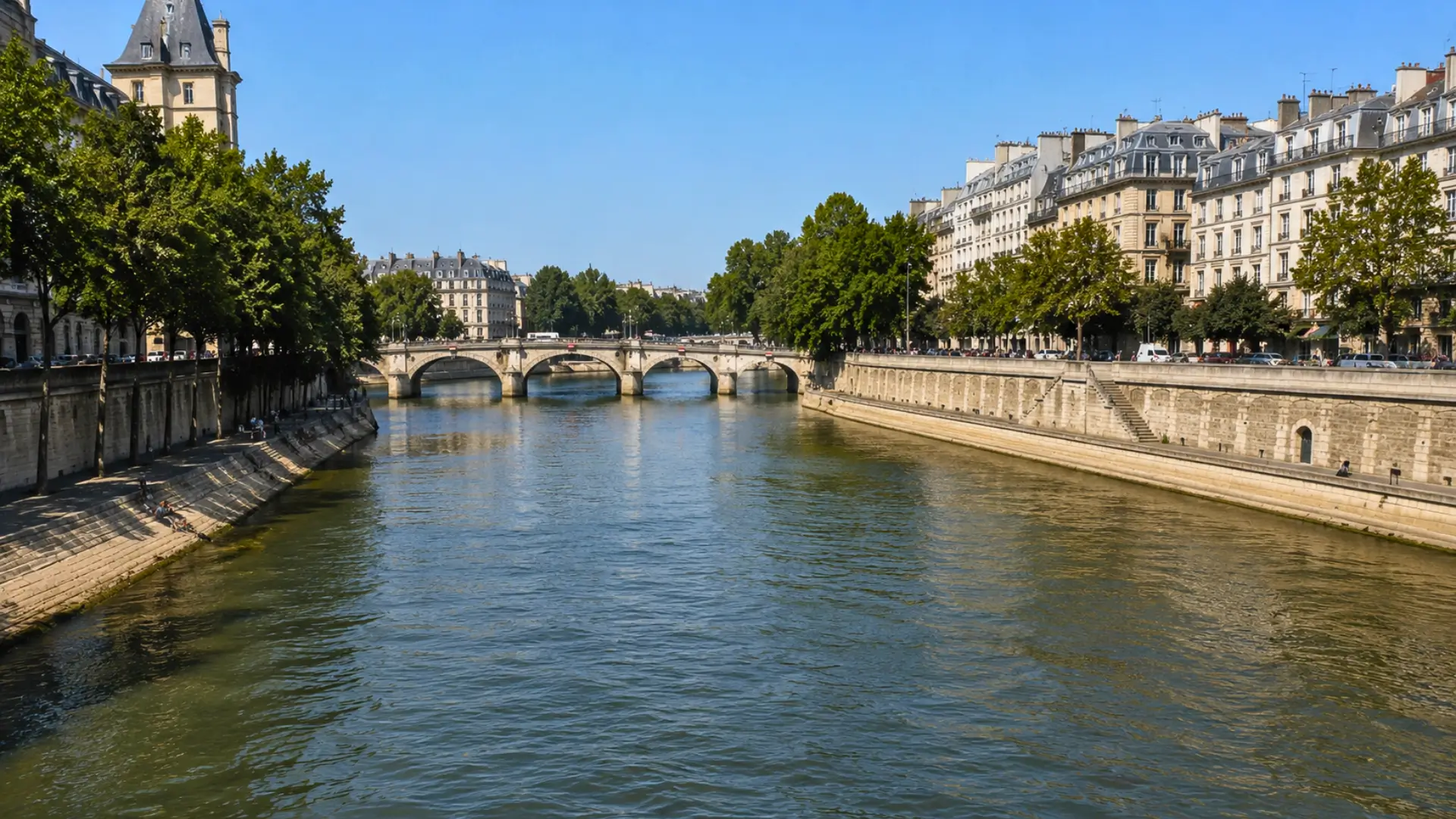
Underneath the bridges of Paris, the Seine appears almost normal. However, a significant intervention is at play, with about 40 percent of its flow now coming from artificial lakes. How long can these reservoirs mask the effects of drought?
Artificially maintained flow despite historic river level decline
At first glance, there seems to be nothing alarming. Tour boats are in operation, the quays are lively, and the Seine flows serenely. However, on July 16, its flow at Paris-Austerlitz measured only 57.3 cubic meters per second, nearly three times lower than the historical average for July.
The river remains above the crisis threshold, set at around 45 cubic meters per second. Yet, this level is maintained by significant external assistance. Every day, managers release about 32 cubic meters of water per second from four large reservoirs. Without these releases, the Seine would quickly plunge below the threshold, triggering restrictions and emergency measures.
Reservoir lakes designed to regulate winter floods and summer droughts
This system was not established in response to recent heatwaves but dates back to the 1930s, following the notable drought of 1921 and several destructive floods. Engineers then devised an ambitious solution: to hold water in winter to limit flooding and release it in summer when rivers are weaker.
Today, this vast reservoir system comprises four main lakes: Lake Der, Lake Orient, the Amance-Temple lakes, and Lake Pannecière. Together, they can store up to 808 million cubic meters of water. Canals, sluices, and movable dams connect these lakes to the rivers, thereby regulating the Marne, Aube, and Yonne.
Think of it as hydraulic lungs. When the basin receives ample water, it fills up. As droughts set in, it slowly releases its reserves. This subtle mechanism safeguards the water supply, navigation, certain industrial activities, and most importantly, ecosystems that depend on a permanent minimum flow to remain habitable.
High-stress management amid early heat and accelerated losses
In 2026, water releases began as early as June 2, about a month sooner than usual. During the intense heat at the end of June, the releases had to be doubled on two occasions. As a result, the reservoirs lose nearly 3 million cubic meters per day, turning each dry week into a relentless countdown.
The heat also acts as an invisible leak. On Lake Der, evaporation reaches about five cubic meters per second. The other lakes, when combined, lose even more. According to Seine Grands Lacs, this evaporation equals a pool evaporating every seven seconds without human intervention.
Widespread drought in france despite the illusion of a stable river
The contrast with smaller French rivers is striking. As of July 1, 2026, the French Biodiversity Office recorded 819 waterways impacted by flow interruptions or drying out. A quarter of the monitored sites faced difficulties, a record level since the ONDE network was created in 2012.
The Seine enjoys an exceptional but limited protection. The four reservoirs were still about 80 percent full by July 10, thanks to a favorable winter. Managers remain optimistic for July and August. However, the real challenge lies in preserving enough water until November, the usual time for rain’s return.
This reliance reveals a reality long hidden beneath the Parisian landscape. A river can seem robust while relying on an infrastructure nearly a century old. If droughts begin earlier and last longer, will there be a need to expand reserves, reduce usage, or learn to view the Seine differently -not as an endless resource but as a fragile balance?