
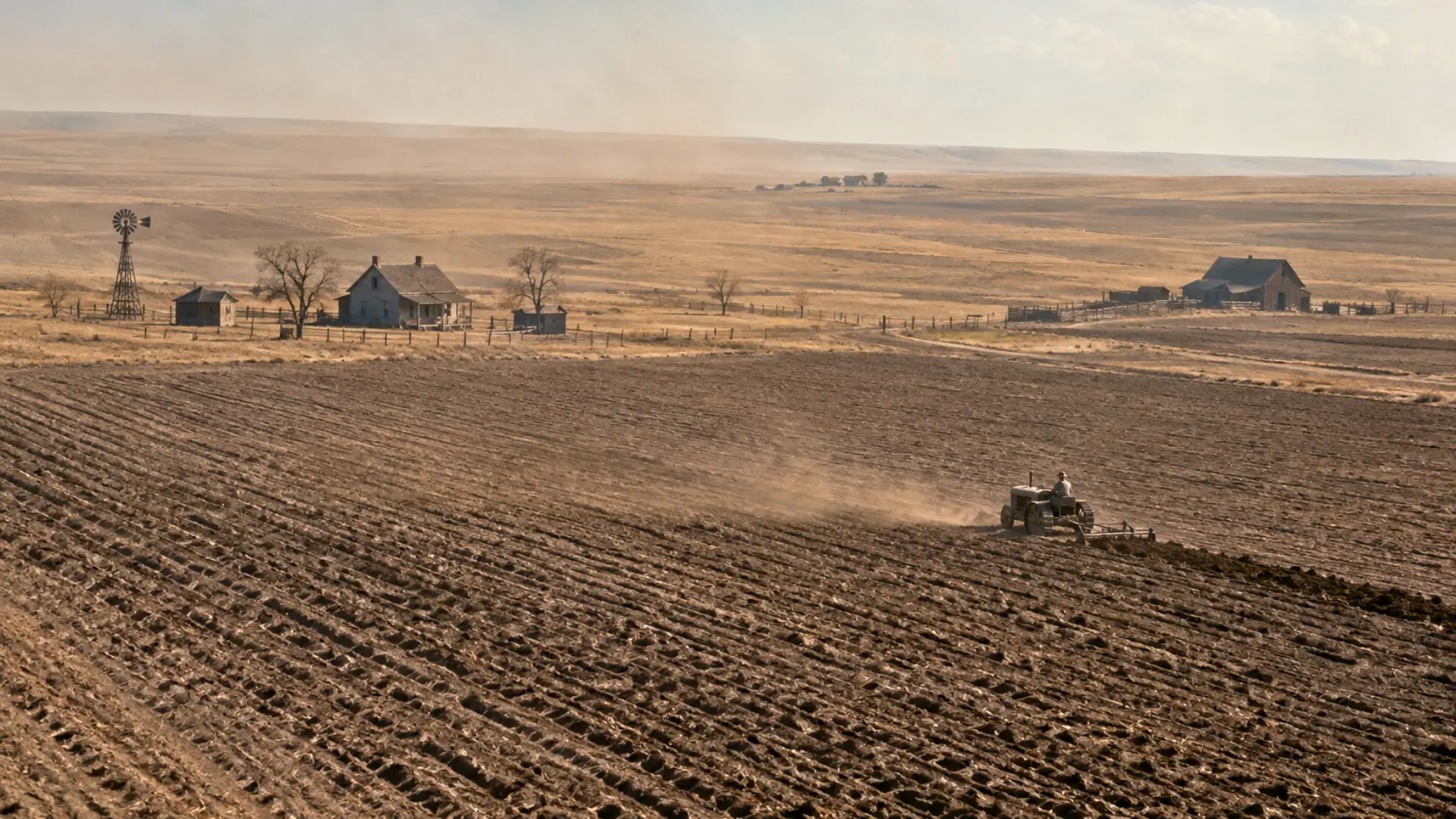
How did wheat fields send their soil all the way to the middle of the Atlantic Ocean? In the 1930s, a mix of drought, mechanization, and intensive plowing transformed the Great Plains of the United States into a massive dust factory.
Before the disaster, millions of acres seemed destined for wealth
In the early 20th century, wheat appeared to be a golden opportunity. The demand created by World War I boosted prices, leading to increased production and faster farming techniques. In the Great Plains, the natural prairie was retreating as tractors and plows opened up previously untouched land.
By the 1920s, this agricultural expansion had accelerated dramatically. Over 33 million acres, roughly 13 million hectares, were plowed in a region that was already fragile. The prairie grasses were not just ornamental; their deep roots played a crucial role in stabilizing the soil and enabling it to withstand both droughts and fierce winds.
When rain disappears, bare fields become vast reserves of dust
Then the skies turned dark. Starting in 1931, several drought episodes hit the Plains, leading to crop failures. What remained was dry, loose soil laid bare. Climate research from NASA has shown that the drought of 1934 was exceptionally severe, even by historical standards.
The issue extended beyond climate conditions. According to the National Drought Mitigation Center, poor agricultural practices exacerbated the situation. The cultivation of marginal land further weakened the area, while effective conservation techniques were abandoned. The disk plow, powerful for turning over prairie, also stripped away the vegetation that held the soil in place.
As agricultural prices plummeted during the Great Depression, the trap closed tighter. To make up for losses, some farmers expanded their fields, believing that producing more would mean making less money in the long run. Yet the soil, already vulnerable and stripped of its plant cover, was a disaster waiting to happen.
On May 1934, 350 million tons of soil literally crossed the United States
On May 9, 1934, dust began to rise over the Great Plains, blown eastward by strong winds. The cloud grew larger as it traveled. In just two days, about 350 million tons of particles were reported reaching the eastern coast, a staggering figure to grasp.
In New York, dust infiltrated every space, severely reducing visibility. The phenomenon became almost surreal over the ocean, as ships located about 300 miles off the coast reported dust accumulating on their decks. The soil stripped from American plains had genuinely reached the Atlantic.
The ‘Black Sunday’ finally makes soil erosion a national issue
On April 14, 1935, another wall of dust engulfed the Great Plains. This “Black Sunday” sometimes reduced visibility to near zero, plunging entire communities into darkness right in the middle of the day. In the aftermath of these storms, the term “Dust Bowl” firmly entered the American lexicon.
Washington recognized that the erosion problem extended far beyond individual farmers. In April 1935, the government established the Soil Conservation Service, the precursor to today’s Natural Resources Conservation Service. New agricultural practices began to spread. Terracing, crop rotations, contour plowing, and vegetation cover became strategies to combat erosion.
These initiatives helped lessen the destructive impact of subsequent droughts. The return of rainfall also played a vital role. The Dust Bowl serves as a lasting reminder of one critical rule: fertile soil is not an inexhaustible resource. Just a few seasons can undo what ecosystems took centuries to build.



