
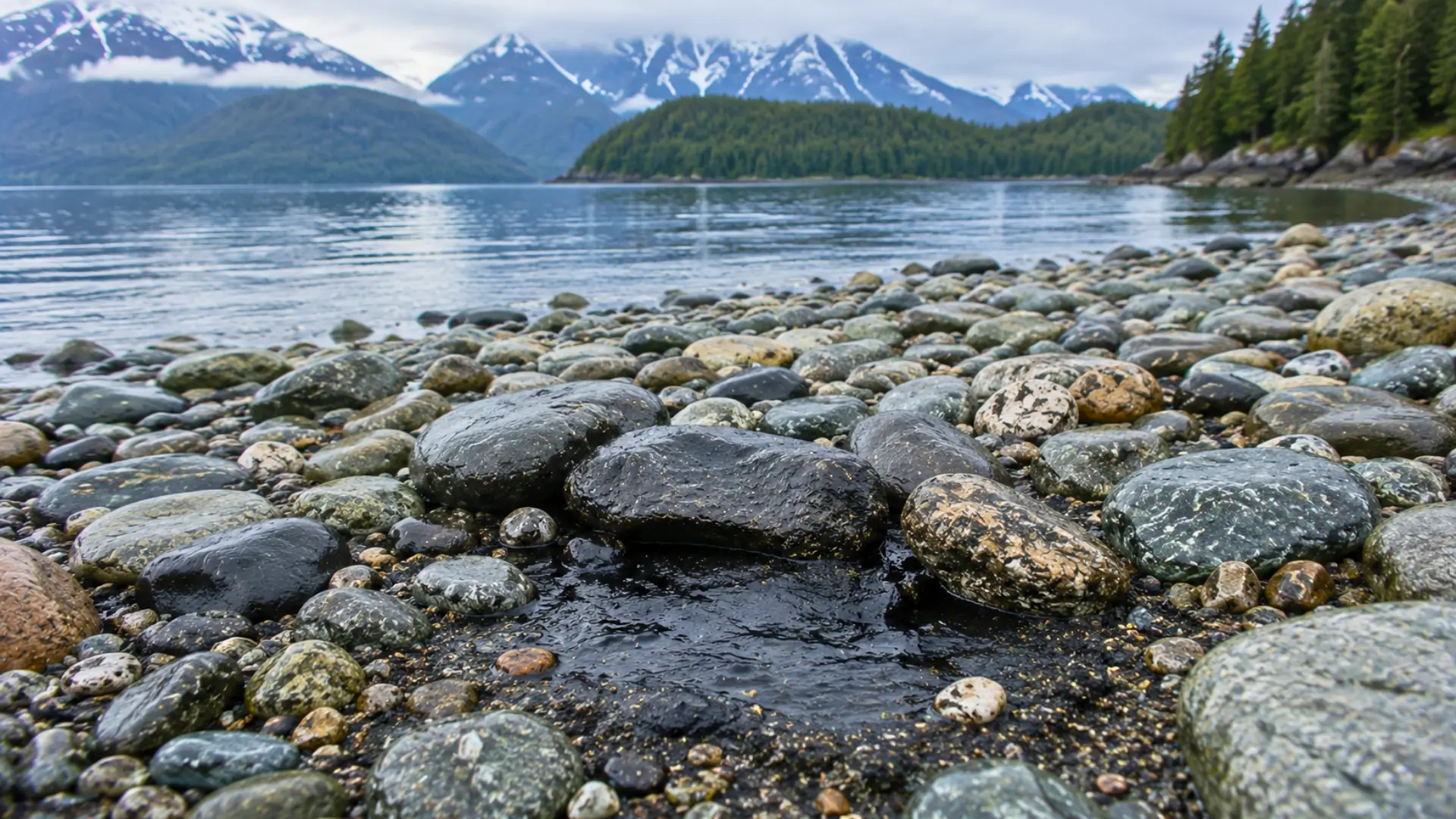
At first glance, some beaches in Alaska appear to have moved on from the Exxon Valdez disaster. However, hidden beneath the stones lies oil that was spilled in 1989. How is it that these hydrocarbons have persisted for nearly four decades in one of America’s wildest landscapes?
The night of 1989 when a tanker veered off course
On March 24, 1989, the Exxon Valdez left the Valdez terminal loaded with crude oil. To navigate around ice, the tanker strayed from its usual route. Shortly after midnight, its hull struck the Bligh Reef. The ship did not sink but ran aground, causing several ruptured tanks to spill their contents into the bay.
Approximately 11 million gallons, or about 42 million liters, leaked into Prince William Sound. The National Transportation Safety Board identified several failures, including the third officer’s fatigue, excessive workload, and the captain’s impaired judgment due to alcohol. Thus, the disaster was the result of a series of poor decisions rather than a single mistake.
The oil spill spreads hundreds of miles and impacts unique wildlife
In the following days, the oil began to move away from the reef. Driven by wind and currents, it reached remote beaches, coves, and islands. Over 2,000 kilometers of coastline were affected to varying degrees, turning a breathtaking shoreline into an unwitting laboratory for studying the effects of an oil spill.
Initial images showed birds coated in oil and otters covered in a dark film. However, counting casualties proved nearly impossible, as many carcasses vanished into the sea. Estimates by NOAA indicate around 250,000 seabirds, 2,800 sea otters, 300 harbor seals, and up to 22 orcas perished.
The impact wasn’t limited to visible animals. Billion of salmon and herring eggs were also likely destroyed. In a region where fishing, food sources, and local economies are closely tied to the marine ecosystem, pollution disrupted an entire chain of life, affecting everything from microscopic organisms to human communities.
Under seemingly clean beaches, oil pockets defy decades
The most startling revelations came long after cleanup efforts. The surface of the coastline gradually regained its natural beauty. Yet, when scientists dug beneath certain pebble beaches, they still found buried oil. A 2015 study found oil at eight of the nine revisited sites, showing no significant changes in composition since 2001.
These pockets persist because of a sort of geological safe. Layers of large pebbles protect fine, low-oxygen sediments where waves have difficulty circulating. As a result, microbes capable of breaking down hydrocarbons operate at a reduced pace. According to the Trustee Council, the loss of this oil could be almost negligible in some years.
Thirty-seven years later, the Exxon Valdez continues to serve as a laboratory
Ongoing monitoring is essential. The Trustee Council’s scientific program continues through 2022-2026 to track these residues. Recent studies indicate that they are diminishing very slowly and remain largely unchanged. Fortunately, current indicators suggest that this sequestered oil is not biodisponible to wildlife today.
The disaster has also driven changes in American regulation. Adopted in 1990, the Oil Pollution Act strengthened financial responsibility after spills and hastened the phase-out of single-hull tankers. American legislation has thus drawn some of its newfound protections from an incident that harshly exposed the failings of oil transportation.
However, a less comfortable lesson remains. Pollution can disappear from sight without truly vanishing from the environment. Thirty-seven years after the grounding, certain molecules from the Exxon Valdez still lie beneath the stones of Alaska. As navigation and exploitation encroach into more remote regions, this buried memory raises a simple question: How long does an ecological disaster actually last?



