Can a wildfire alter the atmosphere thousands of kilometers away from its source? Satellites are now revealing that smoke from some of these massive fires is reaching the stratosphere, filtering solar radiation and disrupting climate balances that were long thought to be out of reach.
Pyrocumulonimbus: towering fire columns piercing the stratosphere
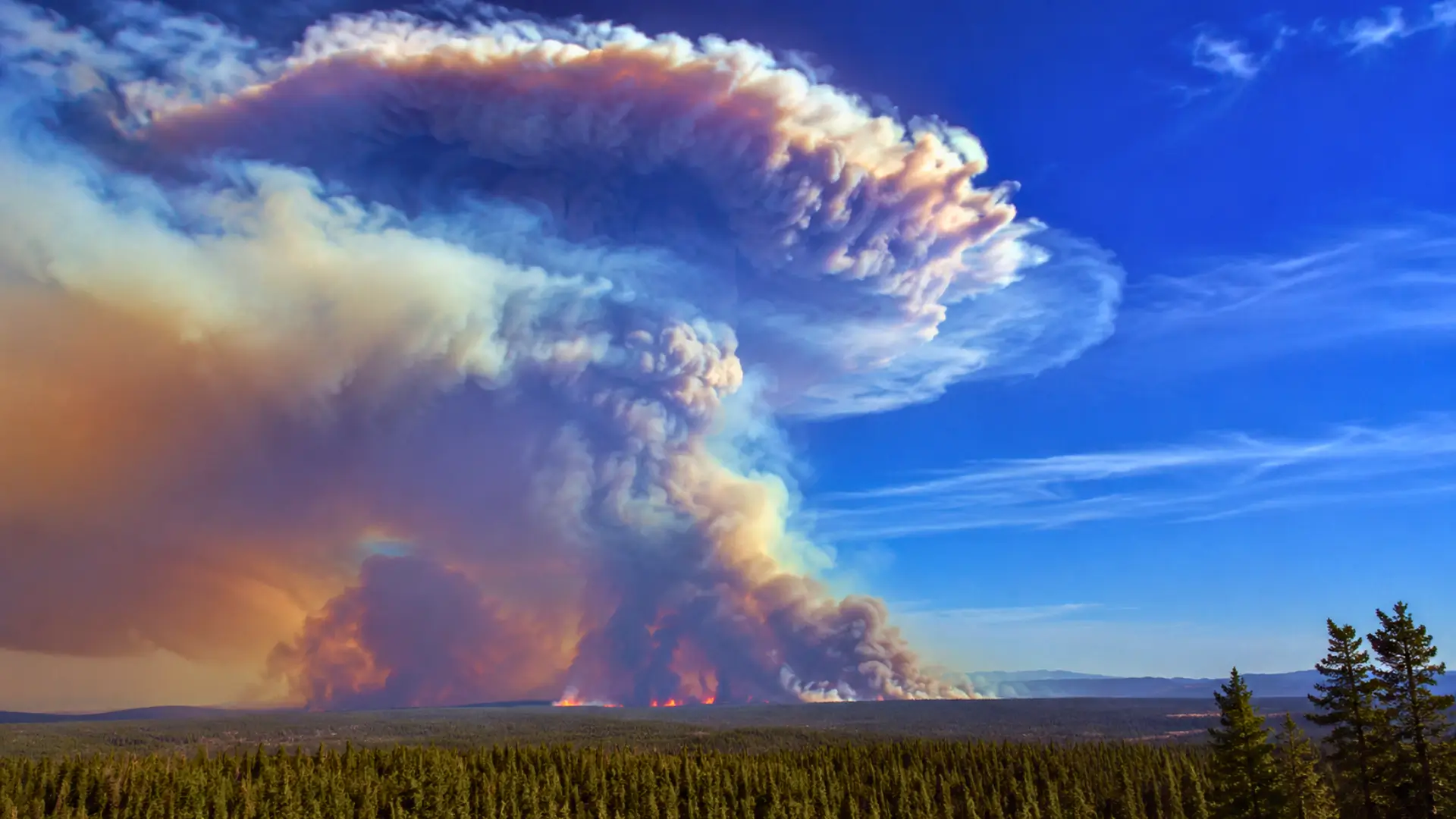
A typical wildfire releases smoke into the lower atmosphere, where winds and rain eventually disperse it. However, when a fire reaches a colossal scale, the intense heat triggers an explosive upward movement of air. This scorching air carries ash, water vapor, and particles at speeds fast enough to create a genuine storm system.
This phenomenon is known as a pyrocumulonimbus, or pyroCb. Similar to a thunderstorm cloud formed by flames, it can soar up to 15 kilometers (or more) into the sky, crossing into the stratosphere. NASA frequently compares it to a gigantic chimney, sending pollution to altitudes where rain can no longer wash it away.
Satellites reveal smoke plumes on a global scale
From the ground, this phenomenon can be nearly invisible. Satellites, however, examine the atmosphere layer by layer using lidars and optical sensors. In June 2025, the European mission EarthCARE detected layers of Canadian smoke stretching over 5,000 kilometers, reaching the high Arctic latitudes.
Observations of the massive Australian fires in 2019 and 2020 revealed an even more astonishing scene. A mass of heat-driven smoke formed a self-contained vortex approximately 1,000 kilometers in diameter. This vortex traveled nearly 66,000 kilometers over thirteen weeks while progressively ascending into the stratosphere.
The plume ultimately reached around 35 kilometers in altitude, well above commercial airliner flight levels. This behavior can be attributed to black carbon particles, which absorb sunlight and heat the surrounding air, aiding further ascension. The smoke practically serves as its own atmospheric elevator.
Smoke aerosols: a solar filter with underestimated climatic effects
At such high altitudes, these particles can linger for weeks or months. They reflect some solar radiation back into space while also absorbing a portion of it. As a result, they can slightly cool the surface while locally warming the stratosphere, leading to complex consequences for winds and atmospheric circulation.
While the comparison to volcanic eruptions is tempting, it is not entirely accurate. Volcanic sulfur primarily forms reflective aerosols, whereas smoke contains dark, heat-absorbing particles. The Australian fires reportedly injected about one-tenth of the aerosol mass released by the eruption of Mount Pinatubo, a remarkable figure for a biological event.
Climate models facing the growing impact of megafires on the atmosphere
For a long time, models treated these stratospheric injections as rare occurrences. However, this assumption is becoming increasingly fragile. A study published in Science estimates that pyrocumulonimbus clouds already influence the average amount of aerosols present in the stratosphere. Over half of several dozen powerful outbursts observed have directly crossed this atmospheric threshold.
The implications extend beyond temperature. Smoke can alter ozone chemistry, which serves as our protective shield against ultraviolet rays. After the Australian fires, researchers observed unprecedented disturbances concentrated in particle-laden vortices. Thus, the ozone layer appears to be more vulnerable to megafires than previously thought.
In 2026, NASA and the Naval Research Laboratory initiated the INSPYRE mission to directly study these fire clouds, their particles, and radiative effects. As warming fosters more intense fires, these incidents could, in turn, modify the climate system. A poorly understood feedback loop is emerging: how far will terrestrial flames transform the skies?