

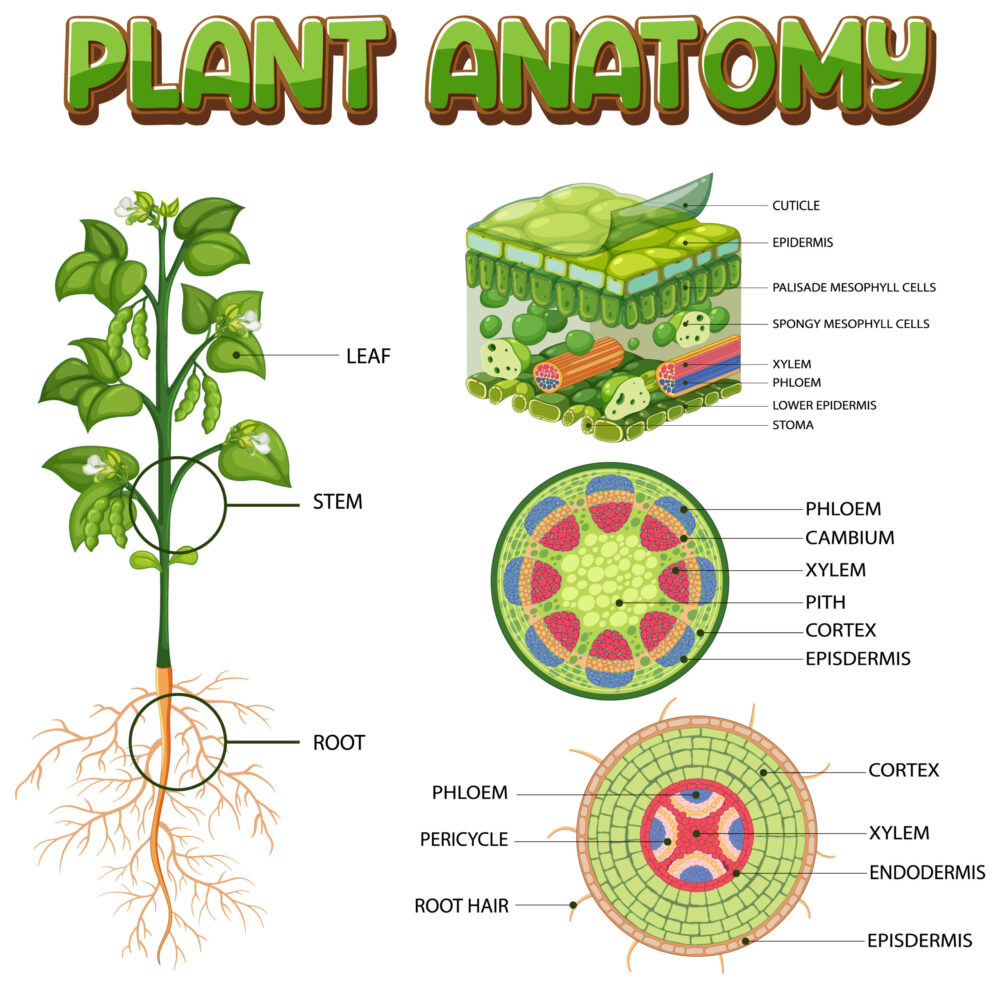
Let’s delve into more detail about plant structure and function:
Plant Structure:
Roots:
- Function: Roots have several essential functions, including anchoring the plant in the soil, absorbing water and minerals, and storing carbohydrates.
- Types:
- Taproots: A single, large, central root, typical in dicotyledonous plants.
- Fibrous roots: A network of fine, slender roots, common in monocotyledonous plants.
- Root Hairs: Tiny hair-like extensions of root epidermal cells that significantly increase the surface area for water and mineral absorption.
Stems:
- Function: Stems provide support for the plant and serve as conduits for the transport of water, minerals, and photosynthetic products (sugars).
- Types:
- Herbaceous Stems: Soft, green, and flexible stems, often found in non-woody plants.
- Woody Stems: Hard, rigid stems with a layer of bark, found in trees and shrubs.
- Vascular Bundles: These are specialized tissues within stems that include xylem (responsible for water and mineral transport) and phloem (responsible for transporting sugars and other organic compounds).
Leaves:
- Function: Leaves are primarily responsible for photosynthesis, the process by which plants convert sunlight, carbon dioxide, and water into glucose and oxygen.
- Structure:
- Epidermis: The outermost layer of cells that provides protection.
- Mesophyll: The middle layer containing chloroplasts, where photosynthesis occurs. It consists of the palisade and spongy mesophyll.
- Stomata: Tiny openings in the epidermis that allow for gas exchange, primarily the uptake of carbon dioxide and the release of oxygen.
- Adaptations: Leaves can vary in shape and size to optimize their function. For example, broad leaves have a larger surface area for photosynthesis, while needle-like leaves reduce water loss.
Plant Function:
Photosynthesis:
- Process: Photosynthesis is the process by which plants convert sunlight into chemical energy in the form of glucose, using carbon dioxide and water. This process takes place in chloroplasts within leaf cells.
- Chloroplasts: These are organelles containing the green pigment chlorophyll, which captures light energy and converts it into chemical energy.
- Equation: The overall equation for photosynthesis is: 6 CO2 + 6 H2O + light energy → C6H12O6 + 6 O2.
- Importance: Photosynthesis provides energy for plant growth and also produces oxygen as a byproduct, essential for many organisms.
Transpiration:
Tropisms:
- Phototropism: Plants exhibit phototropism by growing toward a source of light. This is controlled by the hormone auxin, which promotes cell elongation on the shaded side of the plant.
- Geotropism (Gravitropism): Roots show positive geotropism by growing downward, while shoots display negative geotropism by growing upward. This helps roots reach water and minerals in the soil, while shoots reach sunlight.
- Thigmotropism: Some plants respond to touch or mechanical stimulation by changing their growth patterns. For example, vines may grow toward a support structure.
Plant Hormones:
- Auxins: These hormones promote cell elongation and are involved in phototropism and gravitropism.
- Gibberellins: Gibberellins stimulate stem elongation and fruit growth.
- Ethylene: Ethylene plays a role in fruit ripening and senescence.
- Cytokinins: Cytokinins regulate cell division and promote lateral bud growth.
Defense Mechanisms:
- Chemical Defenses: Some plants produce toxins or secondary metabolites to deter herbivores. Examples include alkaloids, tannins, and essential oils.
- Mechanical Defenses: Plants have evolved structures like thorns, spines, and tough outer layers (e.g., bark) to deter herbivores.
- Mutualistic Relationships: Some plants engage in mutualistic interactions with beneficial organisms, such as mycorrhizal fungi and nitrogen-fixing bacteria, which help with nutrient uptake.
Understanding the intricacies of plant structure and function is crucial for agriculture, ecology, and botany, as it provides insights into how plants grow, adapt, and interact with their environment.