A cell is the basic structural, functional, and biological unit of all living organisms. It is the smallest unit of life and serves as the building block of all living things. Cells are incredibly diverse in terms of their structure and function, yet they all share common characteristics that define them as cells.
Here are some key points about cells:
Cell Structure:
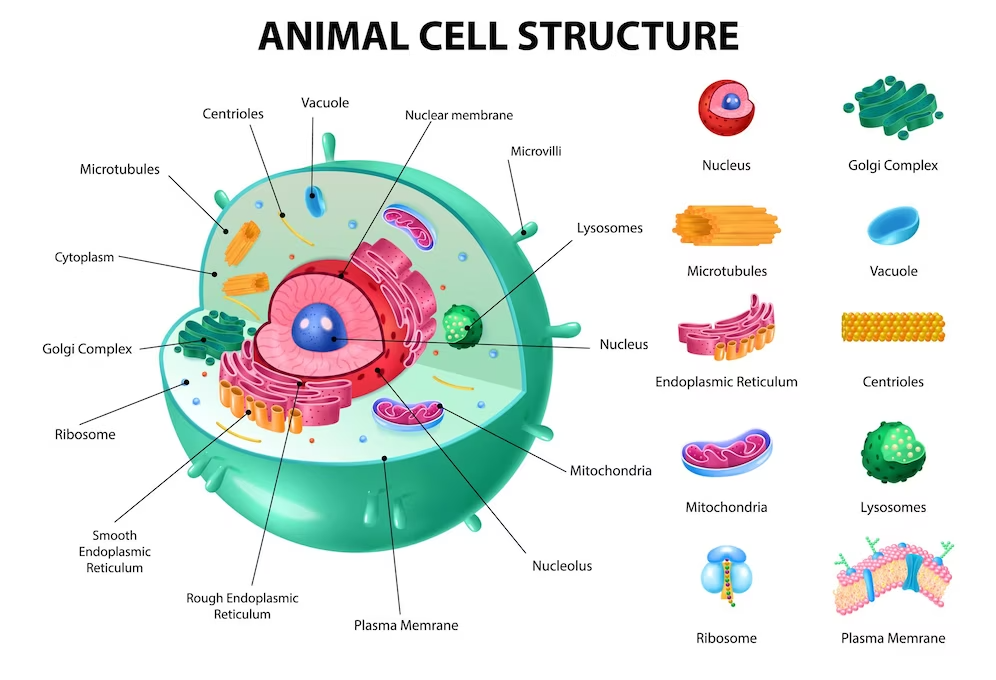
Cells can vary widely in terms of size, shape, and complexity. However, they typically have some common structural components:
- Cell Membrane (Plasma Membrane): This is a thin, semi-permeable barrier that surrounds the cell and separates its internal environment from the external environment. It controls the movement of substances in and out of the cell.
- Cytoplasm: This is a gel-like substance within the cell membrane that houses various organelles and cellular structures.
- Nucleus: In eukaryotic cells (cells with a defined nucleus), the nucleus contains the cell’s genetic material in the form of DNA. It controls the cell’s activities and contains the information necessary for growth, reproduction, and functioning.
Cell Types:
There are two primary categories of cells based on their structural complexity:
- Prokaryotic Cells: These are simpler cells that lack a nucleus and other membrane-bound organelles. Bacteria and archaea are examples of prokaryotic cells.
- Eukaryotic Cells: These cells have a distinct nucleus that houses the genetic material and various membrane-bound organelles that perform specific functions. All plants, animals, fungi, and protists are composed of eukaryotic cells.
Cell Functions:
Cells carry out a wide range of functions that are essential for the survival of an organism. These functions include:
- Metabolism: Cells engage in metabolic processes, including energy production, nutrient processing, and waste elimination.
- Reproduction: Cells reproduce to give rise to new cells, either through cell division (mitosis) in somatic cells or through sexual reproduction in specialized cells (gametes).
- Response to Stimuli: Cells can respond to external and internal stimuli by altering their activities or behavior.
- Homeostasis: Cells maintain a stable internal environment by regulating various factors such as temperature, pH, and ion concentrations.
- Growth and Development: Cells grow in size and number, contributing to an organism’s growth and development.
Cell Specialization:
In multicellular organisms, cells can differentiate and specialize to perform specific functions. This specialization results in the formation of different types of cells, each adapted to carry out particular tasks within the organism.
Cell Theory:
The cell theory is a fundamental concept in biology that states:
- All living organisms are composed of one or more cells.
- The cell is the basic unit of structure, function, and organization in all organisms.
- All cells arise from pre-existing cells through cell division.
The study of cells is known as cell biology or cytology, and it forms the foundation of our understanding of life and living organisms. The discoveries related to cells and their functions have had profound implications for various scientific fields, including medicine, genetics, microbiology, and more.
Image by macrovector on Freepik